SuperTinyKernel™ RTOS 1.06.0
Lightweight, high-performance, deterministic, bare-metal C++ RTOS for resource-constrained embedded systems. MIT Open Source License.
Loading...
Searching...
No Matches
stk::SwitchStrategyEDF Class Reference

Earliest Deadline First (EDF) scheduling strategy: always selects the runnable task with the least time remaining before its deadline expires. More...

#include <stk_strategy_edf.h>

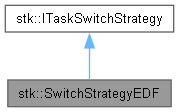
Inheritance diagram for stk::SwitchStrategyEDF:
Collaboration diagram for stk::SwitchStrategyEDF:

Public Types

enum  EConfig {
  WEIGHT_API = 0 ,
  SLEEP_EVENT_API = 1 ,
  DEADLINE_MISSED_API = 0
}
 Compile-time capability flags reported to the kernel. More...

Public Member Functions

 SwitchStrategyEDF ()
 Construct an empty strategy with no tasks.
 ~SwitchStrategyEDF ()
 Destructor.
void AddTask (IKernelTask *task)
 Add task to the runnable set.
void RemoveTask (IKernelTask *task)
 Remove task from whichever list it currently occupies.
IKernelTaskGetNext ()
 Select and return the task with the earliest (minimum) relative deadline.
IKernelTaskGetFirst () const
 Get first task in the managed set (used by the kernel for initial scheduling).
size_t GetSize () const
 Get total number of tasks managed by this strategy.
void OnTaskSleep (IKernelTask *task)
 Notification that a task has entered the sleeping state.
void OnTaskWake (IKernelTask *task)
 Notification that a task has become runnable again.
bool OnTaskDeadlineMissed (IKernelTask *)
 Not supported, asserts unconditionally.

Protected Member Functions

 STK_NONCOPYABLE_CLASS (SwitchStrategyEDF)

Protected Attributes

IKernelTask::ListHeadType m_tasks
 Runnable tasks eligible for scheduling. Scanned in full by GetNext() each tick to find the minimum relative deadline.
IKernelTask::ListHeadType m_sleep
 Sleeping (blocked) tasks not eligible for scheduling. Deadline tracking continues in the kernel while tasks are in this list.

Detailed Description

Earliest Deadline First (EDF) scheduling strategy: always selects the runnable task with the least time remaining before its deadline expires.

Selection metric
GetNext() compares each runnable task's relative deadline, obtained via IKernelTask::GetHrtRelativeDeadline() = deadline - duration (ticks remaining before the task must complete and call Yield()). The task with the minimum relative deadline, i.e. the one closest to missing its deadline is selected.
HRT mode requirement
This strategy is only meaningful when used with KERNEL_HRT mode. In HRT mode the kernel tracks duration (active ticks elapsed) per task, making GetHrtRelativeDeadline() produce meaningful, monotonically decreasing values. Outside HRT mode GetHrtRelativeDeadline() returns 0 for every task, making selection order arbitrary.
Tie-breaking
When two or more tasks share the same relative deadline the first such task encountered during the linear scan of m_tasks wins. Insertion order therefore determines tie priority. This behaviour is implementation-defined and not guaranteed to remain stable across kernel versions.
Complexity
GetNext() performs an O(n) linear scan over all runnable tasks on every call (once per kernel tick). This is inherent to EDF: unlike fixed-priority strategies there is no O(1) data structure that maintains a sorted deadline order under arbitrary insertions and removals without additional memory cost.
Note
This strategy does not use per-task weights (WEIGHT_API = 0). The EDF deadline is tracked internally by the kernel in KERNEL_HRT mode, tasks do not need to override ITask::GetWeight().
Requires the kernel Sleep API (SLEEP_EVENT_API = 1): the kernel must call OnTaskSleep() and OnTaskWake() to maintain the runnable/sleeping list split.
Unlike SwitchStrategyRoundRobin and SwitchStrategyFixedPriority, EDF maintains no per-task cursor. Task insertion and removal do not update any scheduling state beyond the list membership, all scheduling decisions are deferred to GetNext().
See also
ITaskSwitchStrategy, IKernelTask::GetHrtRelativeDeadline

Definition at line 60 of file stk_strategy_edf.h.

Member Enumeration Documentation

◆ EConfig

Compile-time capability flags reported to the kernel.

Enumerator
WEIGHT_API 

This strategy does not use per-task weights. Deadline tracking is handled by the kernel in KERNEL_HRT mode via GetHrtRelativeDeadline().

SLEEP_EVENT_API 

This strategy requires OnTaskSleep() / OnTaskWake() events to move tasks between the runnable and sleeping lists.

DEADLINE_MISSED_API 

This strategy does not use OnTaskDeadlineMissed() events.

Definition at line 66 of file stk_strategy_edf.h.

67 {
68 WEIGHT_API = 0,
69 SLEEP_EVENT_API = 1,
71 };
@ DEADLINE_MISSED_API
This strategy does not use OnTaskDeadlineMissed() events.
@ SLEEP_EVENT_API
This strategy requires OnTaskSleep() / OnTaskWake() events to move tasks between the runnable and sle...
@ WEIGHT_API
This strategy does not use per-task weights. Deadline tracking is handled by the kernel in KERNEL_HRT...

Constructor & Destructor Documentation

◆ SwitchStrategyEDF()

stk::SwitchStrategyEDF::SwitchStrategyEDF ( )
inlineexplicit

Construct an empty strategy with no tasks.

Definition at line 75 of file stk_strategy_edf.h.

75 : m_tasks(), m_sleep()
76 {}
IKernelTask::ListHeadType m_sleep
Sleeping (blocked) tasks not eligible for scheduling. Deadline tracking continues in the kernel while...
IKernelTask::ListHeadType m_tasks
Runnable tasks eligible for scheduling. Scanned in full by GetNext() each tick to find the minimum re...

References m_sleep, and m_tasks.

Referenced by STK_NONCOPYABLE_CLASS().

Here is the caller graph for this function:

◆ ~SwitchStrategyEDF()

stk::SwitchStrategyEDF::~SwitchStrategyEDF ( )
inline

Destructor.

Note
MISRA deviation: [STK-DEV-005] Rule 10-3-2.

Definition at line 81 of file stk_strategy_edf.h.

82 {}

Member Function Documentation

◆ AddTask()

void stk::SwitchStrategyEDF::AddTask ( IKernelTask * task)
inlinevirtual

Add task to the runnable set.

Parameters
[in]taskTask to add. Must not be NULL and must not already be in any list.
Note
The task is appended to the back of m_tasks. Unlike RR and FP strategies, no cursor or bitmap state is updated here — all scheduling decisions are deferred to GetNext(), which scans m_tasks at selection time.
Insertion order determines tie-breaking: when two tasks share the same relative deadline, the one added earlier (closer to the list head) wins.

Implements stk::ITaskSwitchStrategy.

Definition at line 92 of file stk_strategy_edf.h.

93 {
94 STK_ASSERT(task != nullptr);
95 STK_ASSERT(task->GetHead() == nullptr);
96
97 m_tasks.LinkBack(task);
98 }
#define STK_ASSERT(e)
Runtime assertion. Halts execution if the expression e evaluates to false.
Definition stk_defs.h:330

References stk::util::DListEntry< T, _ClosedLoop >::GetHead(), m_tasks, and STK_ASSERT.

Here is the call graph for this function:

◆ GetFirst()

IKernelTask * stk::SwitchStrategyEDF::GetFirst ( ) const
inlinevirtual

Get first task in the managed set (used by the kernel for initial scheduling).

Returns
The first task in m_tasks if any task is runnable; otherwise the first task in m_sleep. Asserts if the combined set is empty (GetSize() == 0).
Note
Returns the list-head task regardless of its deadline. This is called once at kernel start to seed the initial context; EDF ordering begins with the first GetNext() call.

Implements stk::ITaskSwitchStrategy.

Definition at line 159 of file stk_strategy_edf.h.

160 {
161 STK_ASSERT(GetSize() != 0U);
162
163 if (!m_tasks.IsEmpty())
164 return (*m_tasks.GetFirst());
165 else
166 return (*m_sleep.GetFirst());
167 }
size_t GetSize() const
Get total number of tasks managed by this strategy.

References GetSize(), m_sleep, m_tasks, and STK_ASSERT.

Here is the call graph for this function:

◆ GetNext()

IKernelTask * stk::SwitchStrategyEDF::GetNext ( )
inlinevirtual

Select and return the task with the earliest (minimum) relative deadline.

Returns
The runnable task whose GetHrtRelativeDeadline() is smallest, or NULL if m_tasks is empty (no runnable tasks — kernel will sleep).
Note
Algorithm (O(n) linear scan over runnable tasks):
  1. If m_tasks is empty, return NULL immediately.
  2. Initialise earliest to the first task in m_tasks (acts as the initial minimum sentinel — avoids the need for a special INT32_MAX guard).
  3. Iterate the remaining tasks; replace earliest whenever a task has a strictly smaller GetHrtRelativeDeadline() value.
  4. Return earliest.
Tie-breaking: if two tasks share the same relative deadline the one closer to the head of m_tasks (i.e. added earlier) is returned. This is consistent with AddTask() insertion order.
This method is called once per kernel tick. On an n-task system it performs n−1 comparisons and n GetHrtRelativeDeadline() calls per tick.

Implements stk::ITaskSwitchStrategy.

Definition at line 134 of file stk_strategy_edf.h.

135 {
136 if (m_tasks.IsEmpty())
137 return nullptr; // idle
138
139 IKernelTask *itr = (*m_tasks.GetFirst()), * const start = itr;
140 IKernelTask *earliest = itr;
141
142 do
143 {
144 if (itr->GetHrtRelativeDeadline() < earliest->GetHrtRelativeDeadline())
145 earliest = itr;
146 }
147 while ((itr = (*itr->GetNext())) != start);
148
149 return earliest;
150 }

References stk::IKernelTask::GetHrtRelativeDeadline(), stk::util::DListEntry< T, _ClosedLoop >::GetNext(), and m_tasks.

Here is the call graph for this function:

◆ GetSize()

size_t stk::SwitchStrategyEDF::GetSize ( ) const
inlinevirtual

Get total number of tasks managed by this strategy.

Returns
Sum of tasks in m_tasks (runnable) and m_sleep (sleeping).

Implements stk::ITaskSwitchStrategy.

Definition at line 172 of file stk_strategy_edf.h.

173 {
174 return m_tasks.GetSize() + m_sleep.GetSize();
175 }

References m_sleep, and m_tasks.

Referenced by GetFirst(), and RemoveTask().

Here is the caller graph for this function:

◆ OnTaskDeadlineMissed()

bool stk::SwitchStrategyEDF::OnTaskDeadlineMissed ( IKernelTask * )
inlinevirtual

Not supported, asserts unconditionally.

Note
This strategy uses DEADLINE_MISSED_API = 0. See OnTaskDeadlineMissed() for rationale.

Implements stk::ITaskSwitchStrategy.

Definition at line 214 of file stk_strategy_edf.h.

215 {
216 // Budget Overrun API unsupported
217 STK_ASSERT(false);
218 return false;
219 }

References STK_ASSERT.

◆ OnTaskSleep()

void stk::SwitchStrategyEDF::OnTaskSleep ( IKernelTask * task)
inlinevirtual

Notification that a task has entered the sleeping state.

Parameters
[in]taskThe task that is now sleeping. Must be in m_tasks (asserted).
Note
Unlinks from m_tasks and appends to m_sleep. No cursor or bitmap state is affected — EDF maintains no per-task cursor, so this is a simpler operation than the equivalent in RR or FP strategies.

Implements stk::ITaskSwitchStrategy.

Definition at line 183 of file stk_strategy_edf.h.

184 {
185 STK_ASSERT(task != nullptr);
186 STK_ASSERT(task->IsSleeping());
187 STK_ASSERT(task->GetHead() == &m_tasks);
188
189 m_tasks.Unlink(task);
190 m_sleep.LinkBack(task);
191 }

References stk::util::DListEntry< T, _ClosedLoop >::GetHead(), stk::IKernelTask::IsSleeping(), m_sleep, m_tasks, and STK_ASSERT.

Here is the call graph for this function:

◆ OnTaskWake()

void stk::SwitchStrategyEDF::OnTaskWake ( IKernelTask * task)
inlinevirtual

Notification that a task has become runnable again.

Parameters
[in]taskThe task that woke up. Must be in m_sleep (asserted).
Note
Unlinks from m_sleep and appends to the back of m_tasks. No priority boost is applied (unlike SwitchStrategySmoothWeightedRoundRobin) and no bitmap is updated (unlike SwitchStrategyFixedPriority). The waking task's deadline urgency is determined naturally by GetHrtRelativeDeadline() on the next GetNext() call.

Implements stk::ITaskSwitchStrategy.

Definition at line 201 of file stk_strategy_edf.h.

202 {
203 STK_ASSERT(task != nullptr);
204 STK_ASSERT(!task->IsSleeping());
205 STK_ASSERT(task->GetHead() == &m_sleep);
206
207 m_sleep.Unlink(task);
208 m_tasks.LinkBack(task);
209 }

References stk::util::DListEntry< T, _ClosedLoop >::GetHead(), stk::IKernelTask::IsSleeping(), m_sleep, m_tasks, and STK_ASSERT.

Here is the call graph for this function:

◆ RemoveTask()

void stk::SwitchStrategyEDF::RemoveTask ( IKernelTask * task)
inlinevirtual

Remove task from whichever list it currently occupies.

Parameters
[in]taskTask to remove. Must not be NULL and must belong to either m_tasks or m_sleep (asserted).
Note
Dispatch is by list membership check. No cursor or bitmap state is affected because EDF maintains no per-task scheduling state outside list membership.

Implements stk::ITaskSwitchStrategy.

Definition at line 106 of file stk_strategy_edf.h.

107 {
108 STK_ASSERT(task != nullptr);
109 STK_ASSERT(GetSize() != 0U);
110 STK_ASSERT((task->GetHead() == &m_tasks) || (task->GetHead() == &m_sleep));
111
112 if (task->GetHead() == &m_tasks)
113 m_tasks.Unlink(task);
114 else
115 m_sleep.Unlink(task);
116 }

References stk::util::DListEntry< T, _ClosedLoop >::GetHead(), GetSize(), m_sleep, m_tasks, and STK_ASSERT.

Here is the call graph for this function:

◆ STK_NONCOPYABLE_CLASS()

stk::SwitchStrategyEDF::STK_NONCOPYABLE_CLASS ( SwitchStrategyEDF )
protected

References SwitchStrategyEDF().

Here is the call graph for this function:

Member Data Documentation

◆ m_sleep

IKernelTask::ListHeadType stk::SwitchStrategyEDF::m_sleep
protected

Sleeping (blocked) tasks not eligible for scheduling. Deadline tracking continues in the kernel while tasks are in this list.

Definition at line 225 of file stk_strategy_edf.h.

Referenced by GetFirst(), GetSize(), OnTaskSleep(), OnTaskWake(), RemoveTask(), and SwitchStrategyEDF().

◆ m_tasks

IKernelTask::ListHeadType stk::SwitchStrategyEDF::m_tasks
protected

Runnable tasks eligible for scheduling. Scanned in full by GetNext() each tick to find the minimum relative deadline.

Definition at line 224 of file stk_strategy_edf.h.

Referenced by AddTask(), GetFirst(), GetNext(), GetSize(), OnTaskSleep(), OnTaskWake(), RemoveTask(), and SwitchStrategyEDF().


The documentation for this class was generated from the following file: