SuperTinyKernel™ RTOS 1.06.0
Lightweight, high-performance, deterministic, bare-metal C++ RTOS for resource-constrained embedded systems. MIT Open Source License.
Loading...
Searching...
No Matches
stk::util::DListHead< T, _ClosedLoop > Class Template Reference

Intrusive doubly-linked list container. Manages a collection of DListEntry nodes embedded in host objects of type T. More...

#include <stk_linked_list.h>

Inheritance diagram for stk::util::DListHead< T, _ClosedLoop >:
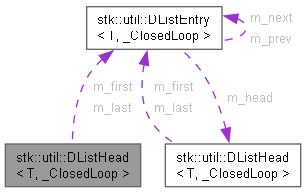
Collaboration diagram for stk::util::DListHead< T, _ClosedLoop >:

Public Types

typedef DListEntry< T, _ClosedLoop > DLEntryType
 Convenience alias for the node type stored in this list.

Public Member Functions

 DListHead ()
 Construct an empty list head (count = 0, first = last = NULL).
size_t GetSize () const
 Get the number of entries currently in the list.
bool IsEmpty () const
 Check whether the list contains no entries.
DLEntryTypeGetFirst () const
 Get the first (front) entry without removing it.
DLEntryTypeGetLast () const
 Get the last (back) entry without removing it.
void Clear ()
 Remove and unlink all entries. After this call the list is empty.
void LinkBack (DLEntryType *entry)
 Append entry to the back of the list (pointer overload).
void LinkBack (DLEntryType &entry)
 Append entry to the back of the list (reference overload).
void LinkFront (DLEntryType *entry)
 Prepend entry to the front of the list (pointer overload).
void LinkFront (DLEntryType &entry)
 Prepend entry to the front of the list (reference overload).
DLEntryTypePopBack ()
 Remove and return the last entry.
DLEntryTypePopFront ()
 Remove and return the first entry.
void Unlink (DLEntryType *entry)
 Remove entry from this list.
void RelinkTo (DListHead &to)
 Move all entries from this list to the back of to, preserving order.
void Link (DLEntryType *entry, DLEntryType *next=nullptr, DLEntryType *prev=nullptr)
 Insert entry into the list between prev and next.

Private Member Functions

void UpdateEnds ()
 Repair the boundary and circular pointers after every structural change.

Private Attributes

size_t m_count
 Number of entries currently in the list.
DLEntryTypem_first
 Pointer to the first (front) entry, or NULL when empty.
DLEntryTypem_last
 Pointer to the last (back) entry, or NULL when empty.

Friends

class DListEntry< T, _ClosedLoop >

Detailed Description

template<class T, bool _ClosedLoop>
class stk::util::DListHead< T, _ClosedLoop >

Intrusive doubly-linked list container. Manages a collection of DListEntry nodes embedded in host objects of type T.

Template Parameters
TThe host class whose instances are stored in this list. Each T must derive from DListEntry<T, _ClosedLoop>.
_ClosedLoopWhen true the list is maintained as a circular ring: after every insertion or removal, last->next is set to first and first->prev is set to last. This allows scheduler algorithms to wrap around the end of the list in O(1) without a branch. When false the boundary pointers remain NULL (standard open list).
Note
Complexity: all operations are O(1) except Clear() and RelinkTo() which are O(n).
An entry may only be in one list at a time. Attempting to insert an already-linked entry will trigger an assertion.
PopBack() and PopFront() call Unlink() internally. Calling them on an empty list will pass NULL to Unlink() and trigger an assertion. Guard with IsEmpty().
Not thread-safe. The caller is responsible for protecting concurrent access with a hw::CriticalSection or equivalent.

Definition at line 195 of file stk_linked_list.h.

Member Typedef Documentation

◆ DLEntryType

template<class T, bool _ClosedLoop>
typedef DListEntry<T, _ClosedLoop> stk::util::DListHead< T, _ClosedLoop >::DLEntryType

Convenience alias for the node type stored in this list.

Definition at line 203 of file stk_linked_list.h.

Constructor & Destructor Documentation

◆ DListHead()

template<class T, bool _ClosedLoop>
stk::util::DListHead< T, _ClosedLoop >::DListHead ( )
inlineexplicit

Construct an empty list head (count = 0, first = last = NULL).

Definition at line 207 of file stk_linked_list.h.

207 : m_count(0), m_first(nullptr), m_last(nullptr)
208 {}
DLEntryType * m_first
Pointer to the first (front) entry, or NULL when empty.
size_t m_count
Number of entries currently in the list.
DLEntryType * m_last
Pointer to the last (back) entry, or NULL when empty.

References m_count, m_first, and m_last.

Referenced by RelinkTo().

Here is the caller graph for this function:

Member Function Documentation

◆ Clear()

template<class T, bool _ClosedLoop>
void stk::util::DListHead< T, _ClosedLoop >::Clear ( )
inline

Remove and unlink all entries. After this call the list is empty.

Note
Runs in O(n). Each entry is individually unlinked so its pointers are reset to NULL and it is left in a clean state suitable for re-insertion.

Definition at line 234 of file stk_linked_list.h.

234{ while (!IsEmpty()) Unlink(m_first); }
bool IsEmpty() const
Check whether the list contains no entries.
void Unlink(DLEntryType *entry)
Remove entry from this list.

References IsEmpty(), m_first, and Unlink().

Here is the call graph for this function:

◆ GetFirst()

template<class T, bool _ClosedLoop>
DLEntryType * stk::util::DListHead< T, _ClosedLoop >::GetFirst ( ) const
inline

Get the first (front) entry without removing it.

Returns
Pointer to the first DListEntry, or NULL if the list is empty.

Definition at line 223 of file stk_linked_list.h.

223{ return m_first; }

References m_first.

Referenced by stk::SchedulabilityCheck::IsSchedulableWCRT().

Here is the caller graph for this function:

◆ GetLast()

template<class T, bool _ClosedLoop>
DLEntryType * stk::util::DListHead< T, _ClosedLoop >::GetLast ( ) const
inline

Get the last (back) entry without removing it.

Returns
Pointer to the last DListEntry, or NULL if the list is empty.

Definition at line 228 of file stk_linked_list.h.

228{ return m_last; }

References m_last.

◆ GetSize()

template<class T, bool _ClosedLoop>
size_t stk::util::DListHead< T, _ClosedLoop >::GetSize ( ) const
inline

Get the number of entries currently in the list.

Returns
Element count.

Definition at line 213 of file stk_linked_list.h.

213{ return m_count; }

References m_count.

Referenced by stk::SchedulabilityCheck::IsSchedulableWCRT().

Here is the caller graph for this function:

◆ IsEmpty()

template<class T, bool _ClosedLoop>
bool stk::util::DListHead< T, _ClosedLoop >::IsEmpty ( ) const
inline

Check whether the list contains no entries.

Returns
true if empty; false otherwise.

Definition at line 218 of file stk_linked_list.h.

218{ return (m_count == 0); }

References m_count.

Referenced by Clear(), RelinkTo(), and UpdateEnds().

Here is the caller graph for this function:

◆ Link()

template<class T, bool _ClosedLoop>
void stk::util::DListHead< T, _ClosedLoop >::Link ( DLEntryType * entry,
DLEntryType * next = nullptr,
DLEntryType * prev = nullptr )
inline

Insert entry into the list between prev and next.

Parameters
[in]entryEntry to insert. Must be non-NULL and not currently linked.
[in]nextEntry that will follow entry after insertion, or NULL to append.
[in]prevEntry that will precede entry after insertion, or NULL to prepend.
Note
When prev is NULL the method treats this as a front-insertion: next is overridden to m_first so entry becomes the new first element.
Updates m_first and m_last as needed. For closed-loop lists, calls UpdateEnds() to maintain the circular back-link from last to first.

Definition at line 330 of file stk_linked_list.h.

331 {
332 STK_ASSERT(entry != nullptr);
333 STK_ASSERT(!entry->IsLinked());
334
335 if (prev == nullptr)
336 next = m_first;
337
338 ++m_count;
339 entry->Link(this, next, prev);
340
341 if ((m_first == nullptr) || (m_first == entry->GetNext()))
342 m_first = entry;
343
344 if ((m_last == nullptr) || (m_last == entry->GetPrev()))
345 m_last = entry;
346
347 if (_ClosedLoop)
348 UpdateEnds();
349 }
#define STK_ASSERT(e)
Runtime assertion. Halts execution if the expression e evaluates to false.
Definition stk_defs.h:330
Intrusive doubly-linked list container. Manages a collection of DListEntry nodes embedded in host obj...
void Link(DLEntryType *entry, DLEntryType *next=nullptr, DLEntryType *prev=nullptr)
Insert entry into the list between prev and next.
void UpdateEnds()
Repair the boundary and circular pointers after every structural change.

References stk::util::DListEntry< T, _ClosedLoop >::GetNext(), stk::util::DListEntry< T, _ClosedLoop >::GetPrev(), stk::util::DListEntry< T, _ClosedLoop >::IsLinked(), stk::util::DListEntry< T, _ClosedLoop >::Link(), m_count, m_first, m_last, STK_ASSERT, and UpdateEnds().

Referenced by LinkBack(), LinkBack(), LinkFront(), and LinkFront().

Here is the call graph for this function:
Here is the caller graph for this function:

◆ LinkBack() [1/2]

template<class T, bool _ClosedLoop>
void stk::util::DListHead< T, _ClosedLoop >::LinkBack ( DLEntryType & entry)
inline

Append entry to the back of the list (reference overload).

Parameters
[in]entryEntry to insert. Must not already be linked to any list.

Definition at line 244 of file stk_linked_list.h.

244{ Link(&entry, nullptr, m_last); }

References Link(), and m_last.

Here is the call graph for this function:

◆ LinkBack() [2/2]

template<class T, bool _ClosedLoop>
void stk::util::DListHead< T, _ClosedLoop >::LinkBack ( DLEntryType * entry)
inline

Append entry to the back of the list (pointer overload).

Parameters
[in]entryEntry to insert. Must not already be linked to any list.

Definition at line 239 of file stk_linked_list.h.

239{ Link(entry, nullptr, m_last); }

References Link(), and m_last.

Referenced by RelinkTo().

Here is the call graph for this function:
Here is the caller graph for this function:

◆ LinkFront() [1/2]

template<class T, bool _ClosedLoop>
void stk::util::DListHead< T, _ClosedLoop >::LinkFront ( DLEntryType & entry)
inline

Prepend entry to the front of the list (reference overload).

Parameters
[in]entryEntry to insert. Must not already be linked to any list.

Definition at line 256 of file stk_linked_list.h.

256{ Link(&entry, m_last, nullptr); }

References Link(), and m_last.

Here is the call graph for this function:

◆ LinkFront() [2/2]

template<class T, bool _ClosedLoop>
void stk::util::DListHead< T, _ClosedLoop >::LinkFront ( DLEntryType * entry)
inline

Prepend entry to the front of the list (pointer overload).

Parameters
[in]entryEntry to insert. Must not already be linked to any list.
Note
In an open list, entry becomes the new first element. In a closed loop, the circular pointers are updated by UpdateEnds().

Definition at line 251 of file stk_linked_list.h.

251{ Link(entry, m_last, nullptr); }

References Link(), and m_last.

Here is the call graph for this function:

◆ PopBack()

template<class T, bool _ClosedLoop>
DLEntryType * stk::util::DListHead< T, _ClosedLoop >::PopBack ( )
inline

Remove and return the last entry.

Returns
Pointer to the removed entry.
Warning
Triggers an assertion if the list is empty (Unlink receives NULL). Always check IsEmpty() before calling.

Definition at line 263 of file stk_linked_list.h.

264 {
266 Unlink(ret);
267 return ret;
268 }
DListEntry< T, _ClosedLoop > DLEntryType
Convenience alias for the node type stored in this list.

References m_last, and Unlink().

Here is the call graph for this function:

◆ PopFront()

template<class T, bool _ClosedLoop>
DLEntryType * stk::util::DListHead< T, _ClosedLoop >::PopFront ( )
inline

Remove and return the first entry.

Returns
Pointer to the removed entry.
Warning
Triggers an assertion if the list is empty (Unlink receives NULL). Always check IsEmpty() before calling.

Definition at line 275 of file stk_linked_list.h.

276 {
278 Unlink(ret);
279 return ret;
280 }

References m_first, and Unlink().

Referenced by RelinkTo().

Here is the call graph for this function:
Here is the caller graph for this function:

◆ RelinkTo()

template<class T, bool _ClosedLoop>
void stk::util::DListHead< T, _ClosedLoop >::RelinkTo ( DListHead< T, _ClosedLoop > & to)
inline

Move all entries from this list to the back of to, preserving order.

Parameters
[in]toDestination list. Must not be the same object as *this.
Note
After this call *this is empty and every entry that was here is now at the back of to, in the same relative order.
Asserts that to is not the same list as *this.

Definition at line 311 of file stk_linked_list.h.

312 {
313 STK_ASSERT(&to != this);
314
315 while (!this->IsEmpty())
316 {
317 to.LinkBack(this->PopFront());
318 }
319 }
DLEntryType * PopFront()
Remove and return the first entry.
void LinkBack(DLEntryType *entry)
Append entry to the back of the list (pointer overload).

References DListHead(), IsEmpty(), LinkBack(), PopFront(), and STK_ASSERT.

Here is the call graph for this function:

◆ Unlink()

template<class T, bool _ClosedLoop>
void stk::util::DListHead< T, _ClosedLoop >::Unlink ( DLEntryType * entry)
inline

Remove entry from this list.

Parameters
[in]entryEntry to remove. Must be non-NULL, currently linked, and owned by this list.
Note
Asserts that entry is non-NULL, is linked, and belongs to this head. Decrements m_count and calls UpdateEnds() to repair boundary and closed-loop pointers.

Definition at line 287 of file stk_linked_list.h.

288 {
289 STK_ASSERT(entry != nullptr);
290 STK_ASSERT(entry->IsLinked());
291 STK_ASSERT(entry->GetHead() == this);
292
293 if (m_first == entry)
294 m_first = entry->GetNext();
295
296 if (m_last == entry)
297 m_last = entry->GetPrev();
298
299 entry->Unlink();
300 --m_count;
301
302 UpdateEnds();
303 }

References stk::util::DListEntry< T, _ClosedLoop >::GetHead(), stk::util::DListEntry< T, _ClosedLoop >::GetNext(), stk::util::DListEntry< T, _ClosedLoop >::GetPrev(), stk::util::DListEntry< T, _ClosedLoop >::IsLinked(), m_count, m_first, m_last, STK_ASSERT, stk::util::DListEntry< T, _ClosedLoop >::Unlink(), and UpdateEnds().

Referenced by Clear(), PopBack(), and PopFront().

Here is the call graph for this function:
Here is the caller graph for this function:

◆ UpdateEnds()

template<class T, bool _ClosedLoop>
void stk::util::DListHead< T, _ClosedLoop >::UpdateEnds ( )
inlineprivate

Repair the boundary and circular pointers after every structural change.

Note
Called after every insertion and removal. Two responsibilities:
  1. If the list is now empty, resets m_first and m_last to NULL so the head is in a canonical empty state.
  2. If _ClosedLoop is true and the list is non-empty, sets m_last->m_next = m_first and m_first->m_prev = m_last to maintain the circular invariant.
For open lists (_ClosedLoop == false) only the empty-list reset runs; the branch is eliminated at compile time by the constant template parameter.

Definition at line 362 of file stk_linked_list.h.

363 {
364 if (IsEmpty())
365 {
366 m_first = nullptr;
367 m_last = nullptr;
368 }
369 else
370 if (_ClosedLoop)
371 {
372 m_first->m_prev = m_last;
373 m_last->m_next = m_first;
374 }
375 }

References IsEmpty(), m_first, and m_last.

Referenced by Link(), and Unlink().

Here is the call graph for this function:
Here is the caller graph for this function:

◆ DListEntry< T, _ClosedLoop >

template<class T, bool _ClosedLoop>
friend class DListEntry< T, _ClosedLoop >
friend

Definition at line 172 of file stk_linked_list.h.

Member Data Documentation

◆ m_count

template<class T, bool _ClosedLoop>
size_t stk::util::DListHead< T, _ClosedLoop >::m_count
private

Number of entries currently in the list.

Definition at line 377 of file stk_linked_list.h.

Referenced by DListHead(), GetSize(), IsEmpty(), Link(), and Unlink().

◆ m_first

template<class T, bool _ClosedLoop>
DLEntryType* stk::util::DListHead< T, _ClosedLoop >::m_first
private

Pointer to the first (front) entry, or NULL when empty.

Definition at line 378 of file stk_linked_list.h.

Referenced by Clear(), DListHead(), GetFirst(), Link(), PopFront(), Unlink(), and UpdateEnds().

◆ m_last

template<class T, bool _ClosedLoop>
DLEntryType* stk::util::DListHead< T, _ClosedLoop >::m_last
private

Pointer to the last (back) entry, or NULL when empty.

Definition at line 379 of file stk_linked_list.h.

Referenced by DListHead(), GetLast(), Link(), LinkBack(), LinkBack(), LinkFront(), LinkFront(), PopBack(), Unlink(), and UpdateEnds().


The documentation for this class was generated from the following file: