SuperTinyKernel™ RTOS 1.06.x
Lightweight, high-performance, deterministic, bare-metal C++ RTOS for resource-constrained embedded systems. MIT Open Source License.
Loading...
Searching...
No Matches
stk::Kernel< TMode, TSize, TStrategy, TPlatform > Class Template Referencefinal

Concrete implementation of IKernel. More...

#include <stk.h>

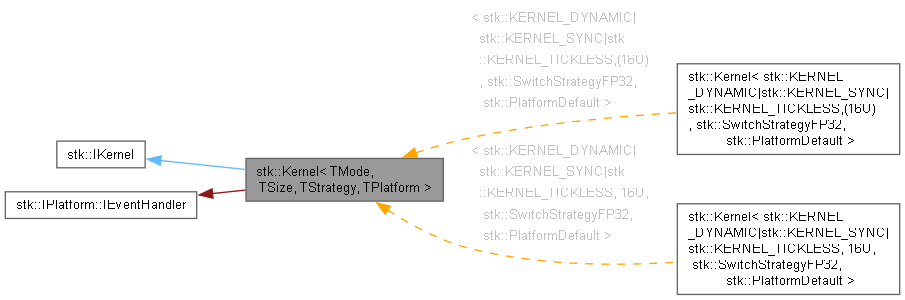
Inheritance diagram for stk::Kernel< TMode, TSize, TStrategy, TPlatform >:
Collaboration diagram for stk::Kernel< TMode, TSize, TStrategy, TPlatform >:

Classes

class  KernelTask
 Internal per-slot kernel descriptor that wraps a user ITask instance. More...
class  KernelService
 Concrete implementation of IKernelService exposed to running tasks. More...
class  SleepTrapStack
 Storage bundle for the sleep trap: a Stack descriptor paired with its backing memory. More...
class  ExitTrapStack
 Storage bundle for the exit trap: a Stack descriptor paired with its backing memory. More...

Public Types

enum  EKernelState : uint8_t {
  KSTATE_INACTIVE = 0 ,
  KSTATE_READY ,
  KSTATE_RUNNING ,
  KSTATE_SUSPENDED
}
 Kernel state. More...

Public Member Functions

 Kernel ()
 Construct the kernel with all storage zero-initialized and the request flag set to ~0 (indicating uninitialized state; cleared to REQ_NONE by Initialize()).
 ~Kernel ()=default
 Destructor.
void Initialize (uint32_t resolution_us=PERIODICITY_DEFAULT) override
 Initialize kernel.
void AddTask (ITask *user_task) override
 Register task for a soft real-time (SRT) scheduling.
void AddTask (ITask *user_task, Timeout periodicity_tc, Timeout deadline_tc, Timeout start_delay_tc) override
 Register a task for hard real-time (HRT) scheduling.
void RemoveTask (ITask *user_task) override
 Remove a previously added task from the kernel before Start().
void ScheduleTaskRemoval (ITask *user_task) override
 Schedule task removal from scheduling (exit).
void SuspendTask (ITask *user_task, bool &suspended) override
 Suspend task.
void ResumeTask (ITask *user_task) override
 Resume task.
size_t EnumerateKernelTasks (ArrayView< IKernelTask * > tasks) override
 Enumerate kernel tasks.
size_t EnumerateTasks (ArrayView< ITask * > user_tasks) override
 Enumerate user tasks.
void Start () override
 Start the scheduler. This call does not return until all tasks have exited (KERNEL_DYNAMIC mode) or indefinitely (KERNEL_STATIC mode).
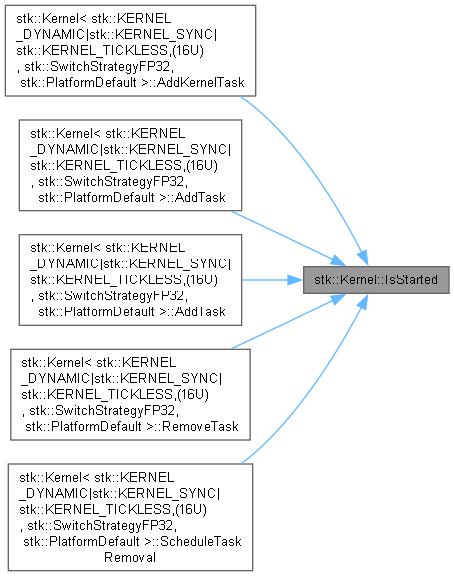
bool IsStarted () const
 Check whether scheduler is currently running.
IPlatformGetPlatform () override
 Get platform driver instance owned by this kernel.
ITaskSwitchStrategyGetSwitchStrategy () override
 Get task-switching strategy instance owned by this kernel.
EKernelState GetState () const override
 Get kernel state.
template<size_t TMaxCount, typename TCallback>
size_t EnumerateTasksT (TCallback &&callback)
 Enumerate tasks, invoking a callback for each active task.

Static Public Attributes

static constexpr size_t TASKS_MAX = TSize
 Maximum number of concurrently registered tasks. Fixed at compile time. Exceeding this limit in AddTask() triggers a compile-time assert (TASKS_MAX > 0) and a runtime STK_ASSERT.

Protected Types

enum  ERequest : uint8_t {
  REQ_NONE = 0 ,
  REQ_ADD_TASK = (1 << 0)
}
 Bitmask flags for pending inter-task requests that must be processed by the kernel on the next tick (in UpdateTaskRequest()). More...
enum  EFsmState : int8_t {
  FSM_STATE_NONE = -1 ,
  FSM_STATE_SWITCHING ,
  FSM_STATE_SLEEPING ,
  FSM_STATE_WAKING ,
  FSM_STATE_EXITING ,
  FSM_STATE_MAX
}
 Finite-state machine (FSM) state. Encodes what the kernel is currently doing between two consecutive tick events. More...
enum  EFsmEvent : int8_t {
  FSM_EVENT_SWITCH = 0 ,
  FSM_EVENT_SLEEP ,
  FSM_EVENT_WAKE ,
  FSM_EVENT_EXIT ,
  FSM_EVENT_MAX
}
 Finite-state machine (FSM) event. Computed by FetchNextEvent() each tick based on strategy output and current kernel state. More...
typedef StackMemoryWrapper<((32U))> SleepTrapStackMemory
 Stack memory wrapper type for the sleep trap.
typedef StackMemoryWrapper< STACK_SIZE_MINExitTrapStackMemory
 Stack memory wrapper type for the exit trap.
typedef KernelTask TaskStorageType[TASKS_MAX]
 KernelTask array type used as a storage for the KernelTask instances.
typedef ISyncObject::ListHeadType SyncObjectList
 Intrusive list of active ISyncObject instances registered with this kernel. Each sync object in this list receives a Tick() call every kernel tick for timeout tracking. Allocated only when KERNEL_SYNC is set (zero-size otherwise).

Protected Member Functions

void InitTraps ()
 Initialize stack of the traps.
KernelTaskAllocateNewTask (ITask *user_task)
 Allocate new instance of KernelTask.
void AddKernelTask (KernelTask *task)
 Add kernel task to the scheduling strategy.
void AllocateAndAddNewTask (ITask *user_task)
 Allocate new instance of KernelTask and add it into the scheduling process.
void HrtAllocateAndAddNewTask (ITask *user_task, Timeout periodicity_tc, Timeout deadline_tc, Timeout start_delay_tc)
 Allocate new instance of KernelTask and add it into the HRT scheduling process.
void RequestAddTask (ITask *const user_task)
 Request to add new task.
KernelTaskFindTaskByUserTask (const ITask *user_task)
 Find kernel task by the bound ITask instance.
KernelTaskFindTaskByStack (const Stack *stack)
 Find kernel task by the bound Stack instance.
KernelTaskFindTaskBySP (Word SP)
 Find kernel task for a Stack Pointer (SP).
void RemoveTask (KernelTask *task)
 Remove kernel task.
void OnStart (Stack *&active) override
 Called by platform driver immediately after a scheduler start (first tick).
void OnStop () override
 Called by the platform driver after a scheduler stop (all tasks have exited).
bool OnTick (Stack *&idle, Stack *&active, Timeout &ticks) override
 Process one scheduler tick. Called from the platform timer/tick ISR.
void OnTaskSwitch (Word caller_SP) override
 Called by Thread process (via IKernelService::SwitchToNext) to switch to a next task.
void OnTaskSleep (Word caller_SP, Timeout ticks) override
 Called by Thread process (via IKernelService::Sleep) for exclusion of the calling process from scheduling (sleeping).
bool OnTaskSleepUntil (Word caller_SP, Ticks timestamp) override
 Called by Thread process (via IKernelService::SleepUntil) for exclusion of the calling process from scheduling (sleeping).
void OnTaskSleepCancel (TId task_id)
void OnTaskExit (Stack *stack) override
 Called from the Thread process when task finished (its Run function exited by return).
IWaitObjectOnTaskWait (Word caller_SP, ISyncObject *sync_obj, IMutex *mutex, Timeout timeout) override
 Called from the Thread process when task needs to wait.
TId OnGetTid (Word caller_SP) override
 Called from the Thread process when for getting task/thread id of the process.
void OnSuspend (bool suspended) override
 Called from the Thread process to suspend scheduling.
void OnInheritWeight (TId tid, Weight weight)
void OnRestoreWeight (TId tid, ISyncObject *sobj)
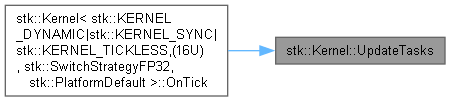
Timeout UpdateTasks (const Timeout elapsed_ticks)
 Update tasks (sleep, requests).
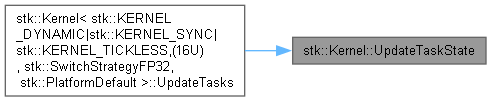
Timeout UpdateTaskState (const Timeout elapsed_ticks)
 Update task state: process removals, advance sleep timers, and track HRT durations.
void UpdateSyncObjects (const Timeout elapsed_ticks)
 Update synchronization objects.
void UpdateTaskRequest ()
 Update pending task requests.
EFsmEvent FetchNextEvent (KernelTask *&next)
 Fetch next event for the FSM.
EFsmState GetNewFsmState (KernelTask *&next)
 Get new FSM state.
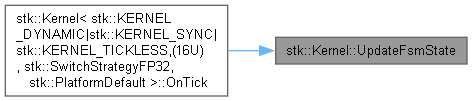
bool UpdateFsmState (Stack *&idle, Stack *&active)
 Update FSM state.
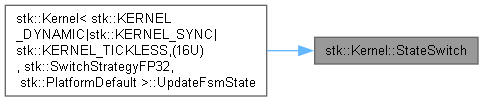
bool StateSwitch (KernelTask *now, KernelTask *next, Stack *&idle, Stack *&active)
 Switches contexts.
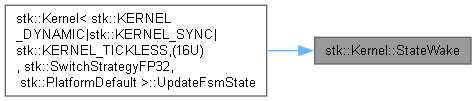
bool StateWake (KernelTask *now, KernelTask *next, Stack *&idle, Stack *&active)
 Wakes up after sleeping.
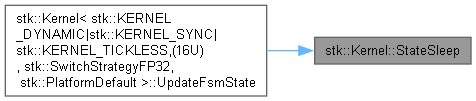
bool StateSleep (KernelTask *now, KernelTask *next, Stack *&idle, Stack *&active)
 Enters into a sleeping mode.
bool StateExit (KernelTask *now, KernelTask *next, Stack *&idle, Stack *&active)
 Exits from scheduling.
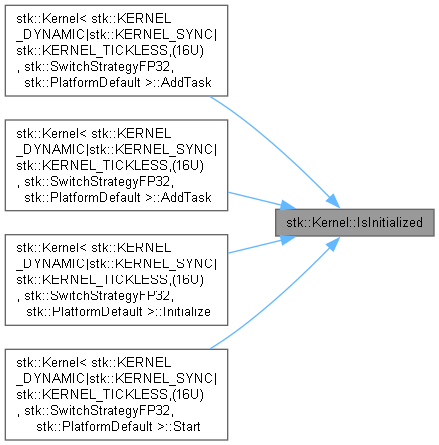
bool IsInitialized () const
 Check whether Initialize() has been called and completed successfully.
void ScheduleAddTask ()
 Signal the kernel to process a pending AddTask request on the next tick.

Static Protected Member Functions

static bool IsValidFsmState (EFsmState state)
 Check if FSM state is valid.
static constexpr bool IsStaticMode ()
static constexpr bool IsDynamicMode ()
static constexpr bool IsHrtMode ()
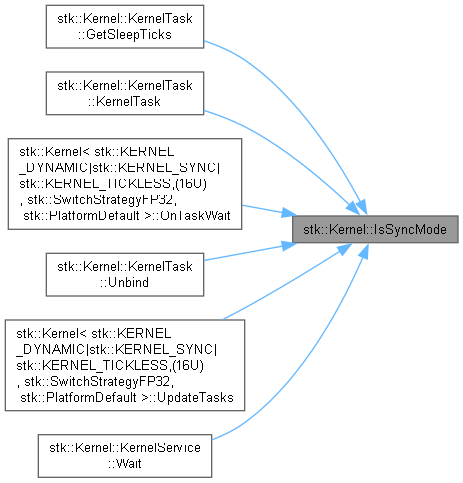
static constexpr bool IsSyncMode ()
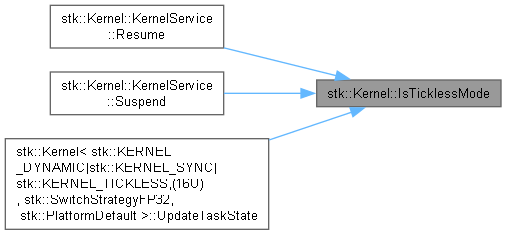
static constexpr bool IsTicklessMode ()

Protected Attributes

KernelService m_service
 Kernel service singleton exposed to running tasks via IKernelService::GetInstance().
TPlatform m_platform
 Platform driver (SysTick, PendSV, context switch implementation).
TStrategy m_strategy
 Task-switching strategy (determines which task runs next).
KernelTaskm_task_now
 Currently executing task, or nullptr before Start() or after all tasks exit.
TaskStorageType m_task_storage
 Static pool of TSize KernelTask slots (free slots have m_user == nullptr).
SleepTrapStack m_sleep_trap [1]
 Sleep trap (always present): executed when all tasks are sleeping.
ExitTrapStack m_exit_trap [STK_ALLOCATE_COUNT< TMode, KERNEL_DYNAMIC, 1U, 0U >::Value]
 Exit trap: zero-size in KERNEL_STATIC mode; one entry in KERNEL_DYNAMIC mode.
EFsmState m_fsm_state
 Current FSM state. Drives context-switch decision on every tick.
volatile uint8_t m_request
 Bitmask of pending ERequest flags from running tasks. Written by tasks, read/cleared by UpdateTaskRequest() in tick context.
volatile EKernelState m_kstate
 Current kernel state.
SyncObjectList m_sync_list [STK_ALLOCATE_COUNT< TMode, KERNEL_SYNC, 1U, 0U >::Value]
 List of active sync objects. Zero-size (no memory) if KERNEL_SYNC is not set.
const EFsmState m_fsm [FSM_STATE_MAX][FSM_EVENT_MAX]

Static Protected Attributes

static constexpr Timeout YIELD_TICKS = 2
 Ticks to yield.

Detailed Description

template<uint8_t TMode, uint32_t TSize, class TStrategy, class TPlatform>
class stk::Kernel< TMode, TSize, TStrategy, TPlatform >

Concrete implementation of IKernel.

All configuration is expressed as template parameters. No virtual dispatch, no heap allocation - the entire kernel, tasks, and traps live in statically reserved storage.

Template Parameters
TModeBitmask of EKernelMode flags that configures kernel features:
  • KERNEL_STATIC - fixed task list, no add/remove after Start().
  • KERNEL_DYNAMIC - tasks may be added or removed at runtime.
  • KERNEL_HRT - Hard Real-Time mode (must combine with STATIC or DYNAMIC).
  • KERNEL_SYNC - enables synchronization primitives (Mutex, Event, etc.).
  • KERNEL_TICKLESS - enables tickless low-power operation. Requires STK_TICKLESS_IDLE=1 in stk_config.h. Incompatible with KERNEL_HRT (tickless suppresses the timer, which destroys the precise periodicity HRT depends on - enforced by the compile-time assertion TICKLESS_HRT_CONFLICT). KERNEL_STATIC and KERNEL_DYNAMIC are mutually exclusive.
TSizeMaximum number of concurrent tasks. Must be > 0.
TStrategyTask-switching strategy type (e.g. SwitchStrategyRoundRobin). Must inherit ITaskSwitchStrategy.
TPlatformPlatform driver type (e.g. PlatformArmCortexM, or PlatformDefault). Must inherit IPlatform.
Note
At least 1 task is required: TSize must be > 0 (enforced by compile-time assertion).
KERNEL_HRT is incompatible with weighted scheduling strategies (WEIGHT_API == true), also enforced by a compile-time assertion.
KERNEL_TICKLESS is incompatible with KERNEL_HRT, also enforced by a compile-time assertion (TICKLESS_HRT_CONFLICT).

Usage example:

static MyTask1<256, ACCESS_PRIVILEGED> task1;
static MyTask2<512, ACCESS_USER> task2;
static MyTask3<512, ACCESS_USER> task3;
kernel.Initialize();
kernel.AddTask(&task1);
kernel.AddTask(&task2);
kernel.AddTask(&task3);
kernel.Start();
Concrete implementation of IKernel.
Definition stk.h:85
void AddTask(ITask *user_task) override
Register task for a soft real-time (SRT) scheduling.
Definition stk.h:1003
void Start() override
Start the scheduler. This call does not return until all tasks have exited (KERNEL_DYNAMIC mode) or i...
Definition stk.h:1229
void Initialize(uint32_t resolution_us=PERIODICITY_DEFAULT) override
Initialize kernel.
Definition stk.h:966

Definition at line 80 of file stk.h.

Member Typedef Documentation

◆ ExitTrapStackMemory

template<uint8_t TMode, uint32_t TSize, class TStrategy, class TPlatform>
typedef StackMemoryWrapper<STACK_SIZE_MIN> stk::Kernel< TMode, TSize, TStrategy, TPlatform >::ExitTrapStackMemory
protected

Stack memory wrapper type for the exit trap.

See also
ExitTrapStack, STACK_SIZE_MIN

Definition at line 97 of file stk.h.

◆ SleepTrapStackMemory

template<uint8_t TMode, uint32_t TSize, class TStrategy, class TPlatform>
typedef StackMemoryWrapper< ( (32U) )> stk::Kernel< TMode, TSize, TStrategy, TPlatform >::SleepTrapStackMemory
protected

Stack memory wrapper type for the sleep trap.

See also
SleepTrapStack, STK_SLEEP_TRAP_STACK_SIZE

Definition at line 91 of file stk.h.

◆ SyncObjectList

template<uint8_t TMode, uint32_t TSize, class TStrategy, class TPlatform>
typedef ISyncObject::ListHeadType stk::Kernel< TMode, TSize, TStrategy, TPlatform >::SyncObjectList
protected

Intrusive list of active ISyncObject instances registered with this kernel. Each sync object in this list receives a Tick() call every kernel tick for timeout tracking. Allocated only when KERNEL_SYNC is set (zero-size otherwise).

Definition at line 2417 of file stk.h.

◆ TaskStorageType

template<uint8_t TMode, uint32_t TSize, class TStrategy, class TPlatform>
typedef KernelTask stk::Kernel< TMode, TSize, TStrategy, TPlatform >::TaskStorageType[TASKS_MAX]
protected

KernelTask array type used as a storage for the KernelTask instances.

Definition at line 2379 of file stk.h.

Member Enumeration Documentation

◆ EFsmEvent

template<uint8_t TMode, uint32_t TSize, class TStrategy, class TPlatform>
enum stk::Kernel::EFsmEvent : int8_t
protected

Finite-state machine (FSM) event. Computed by FetchNextEvent() each tick based on strategy output and current kernel state.

Enumerator
FSM_EVENT_SWITCH 

Strategy returned a runnable task, perform a context switch.

FSM_EVENT_SLEEP 

No runnable tasks, enter sleep trap.

FSM_EVENT_WAKE 

A task became runnable while the kernel was sleeping, wake from sleep trap.

FSM_EVENT_EXIT 

No tasks remain (KERNEL_DYNAMIC), exit scheduling and return from Start().

FSM_EVENT_MAX 

Sentinel: number of valid events (used to size the FSM table).

Definition at line 1294 of file stk.h.

1295 {
1296 FSM_EVENT_SWITCH = 0,
1301 };
@ FSM_EVENT_EXIT
No tasks remain (KERNEL_DYNAMIC), exit scheduling and return from Start().
Definition stk.h:1299
@ FSM_EVENT_WAKE
A task became runnable while the kernel was sleeping, wake from sleep trap.
Definition stk.h:1298
@ FSM_EVENT_SLEEP
No runnable tasks, enter sleep trap.
Definition stk.h:1297
@ FSM_EVENT_SWITCH
Strategy returned a runnable task, perform a context switch.
Definition stk.h:1296
@ FSM_EVENT_MAX
Sentinel: number of valid events (used to size the FSM table).
Definition stk.h:1300

◆ EFsmState

template<uint8_t TMode, uint32_t TSize, class TStrategy, class TPlatform>
enum stk::Kernel::EFsmState : int8_t
protected

Finite-state machine (FSM) state. Encodes what the kernel is currently doing between two consecutive tick events.

Enumerator
FSM_STATE_NONE 

Sentinel / uninitialized value. Set by the constructor, replaced by FSM_STATE_SWITCHING on the first tick.

FSM_STATE_SWITCHING 

Normal operation: switching between runnable tasks each tick.

FSM_STATE_SLEEPING 

All tasks are sleeping, the sleep trap is executing (CPU in low-power state).

FSM_STATE_WAKING 

At least one task woke up, transitioning from sleep trap back to a user task.

FSM_STATE_EXITING 

All tasks exited (KERNEL_DYNAMIC only), executing the exit trap to return from Start().

FSM_STATE_MAX 

Sentinel: number of valid states (used to size the FSM table), denotes uninitialized state.

Definition at line 1280 of file stk.h.

1281 {
1282 FSM_STATE_NONE = -1,
1288 };
@ FSM_STATE_EXITING
All tasks exited (KERNEL_DYNAMIC only), executing the exit trap to return from Start().
Definition stk.h:1286
@ FSM_STATE_SLEEPING
All tasks are sleeping, the sleep trap is executing (CPU in low-power state).
Definition stk.h:1284
@ FSM_STATE_SWITCHING
Normal operation: switching between runnable tasks each tick.
Definition stk.h:1283
@ FSM_STATE_NONE
Sentinel / uninitialized value. Set by the constructor, replaced by FSM_STATE_SWITCHING on the first ...
Definition stk.h:1282
@ FSM_STATE_MAX
Sentinel: number of valid states (used to size the FSM table), denotes uninitialized state.
Definition stk.h:1287
@ FSM_STATE_WAKING
At least one task woke up, transitioning from sleep trap back to a user task.
Definition stk.h:1285

◆ EKernelState

enum stk::IKernel::EKernelState : uint8_t
inherited

Kernel state.

Enumerator
KSTATE_INACTIVE 

Not ready, IKernel::Initialize() must be called.

KSTATE_READY 

Ready to start, IKernel::Start() must be called.

KSTATE_RUNNING 

Initialized and running, IKernel::Start() was called successfully.

KSTATE_SUSPENDED 

Scheduling is suspended with IKernelService::Suspend().

Definition at line 1131 of file stk_common.h.

1132 {
1133 KSTATE_INACTIVE = 0,
1134 KSTATE_READY,
1137 };
@ KSTATE_RUNNING
Initialized and running, IKernel::Start() was called successfully.
@ KSTATE_SUSPENDED
Scheduling is suspended with IKernelService::Suspend().
@ KSTATE_INACTIVE
Not ready, IKernel::Initialize() must be called.
@ KSTATE_READY
Ready to start, IKernel::Start() must be called.

◆ ERequest

template<uint8_t TMode, uint32_t TSize, class TStrategy, class TPlatform>
enum stk::Kernel::ERequest : uint8_t
protected

Bitmask flags for pending inter-task requests that must be processed by the kernel on the next tick (in UpdateTaskRequest()).

Enumerator
REQ_NONE 

No pending requests.

REQ_ADD_TASK 

An AddTask() request is pending from a running task (KERNEL_DYNAMIC only).

Definition at line 103 of file stk.h.

104 {
105 REQ_NONE = 0,
106 REQ_ADD_TASK = (1 << 0)
107 };
@ REQ_ADD_TASK
An AddTask() request is pending from a running task (KERNEL_DYNAMIC only).
Definition stk.h:106
@ REQ_NONE
No pending requests.
Definition stk.h:105

Constructor & Destructor Documentation

◆ Kernel()

template<uint8_t TMode, uint32_t TSize, class TStrategy, class TPlatform>
stk::Kernel< TMode, TSize, TStrategy, TPlatform >::Kernel ( )
inlineexplicit

Construct the kernel with all storage zero-initialized and the request flag set to ~0 (indicating uninitialized state; cleared to REQ_NONE by Initialize()).

Note
In debug builds also verifies that TPlatform derives from IPlatform and TStrategy from ITaskSwitchStrategy.
If TMode includes KERNEL_TICKLESS, a compile-time assertion fires unless STK_TICKLESS_IDLE is defined to 1 in stk_config.h.

Definition at line 933 of file stk.h.

935 {
936 #ifdef _DEBUG
937 // TPlatform must inherit IPlatform
940
941 // TStrategy must inherit ITaskSwitchStrategy
944 #endif
945
946 #if !STK_TICKLESS_IDLE
948 "STK_TICKLESS_IDLE must be defined to 1 for KERNEL_TICKLESS");
949 #endif
950 }
#define STK_UNUSED(X)
Explicitly marks a variable as unused to suppress compiler warnings.
Definition stk_defs.h:608
#define STK_STATIC_ASSERT_DESC(X, DESC)
Compile-time assertion with a custom error description. Produces a compilation error if X is false.
Definition stk_defs.h:429
volatile uint8_t m_request
Bitmask of pending ERequest flags from running tasks. Written by tasks, read/cleared by UpdateTaskReq...
Definition stk.h:2427
TStrategy m_strategy
Task-switching strategy (determines which task runs next).
Definition stk.h:2421
SleepTrapStack m_sleep_trap[1]
Sleep trap (always present): executed when all tasks are sleeping.
Definition stk.h:2424
volatile EKernelState m_kstate
Current kernel state.
Definition stk.h:2428
ExitTrapStack m_exit_trap[STK_ALLOCATE_COUNT< TMode, KERNEL_DYNAMIC, 1U, 0U >::Value]
Exit trap: zero-size in KERNEL_STATIC mode; one entry in KERNEL_DYNAMIC mode.
Definition stk.h:2425
TaskStorageType m_task_storage
Static pool of TSize KernelTask slots (free slots have m_user == nullptr).
Definition stk.h:2423
KernelTask * m_task_now
Currently executing task, or nullptr before Start() or after all tasks exit.
Definition stk.h:2422
TPlatform m_platform
Platform driver (SysTick, PendSV, context switch implementation).
Definition stk.h:2420
EFsmState m_fsm_state
Current FSM state. Drives context-switch decision on every tick.
Definition stk.h:2426

◆ ~Kernel()

template<uint8_t TMode, uint32_t TSize, class TStrategy, class TPlatform>
stk::Kernel< TMode, TSize, TStrategy, TPlatform >::~Kernel ( )
default

Destructor.

Note
MISRA deviation: [STK-DEV-005] Rule 10-3-2.

Member Function Documentation

◆ AddKernelTask()

template<uint8_t TMode, uint32_t TSize, class TStrategy, class TPlatform>
void stk::Kernel< TMode, TSize, TStrategy, TPlatform >::AddKernelTask ( KernelTask * task)
inlineprotected

Add kernel task to the scheduling strategy.

Parameters
[in]taskPointer to the kernel task.

Definition at line 1395 of file stk.h.

1396 {
1397 #if STK_SEGGER_SYSVIEW
1398 // start tracing new task
1399 SEGGER_SYSVIEW_OnTaskCreate(task->GetUserStackPtr()->tid);
1400 if (IsStarted())
1402 #endif
1403
1404 m_strategy.AddTask(task);
1405 }
bool IsStarted() const
Check whether scheduler is currently running.
Definition stk.h:1256

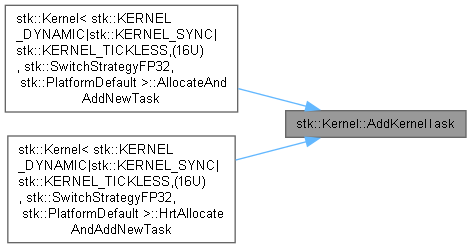
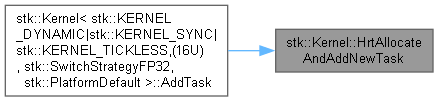
Referenced by stk::Kernel< stk::KERNEL_DYNAMIC|stk::KERNEL_SYNC|stk::KERNEL_TICKLESS,(16U), stk::SwitchStrategyFP32, stk::PlatformDefault >::AllocateAndAddNewTask(), and stk::Kernel< stk::KERNEL_DYNAMIC|stk::KERNEL_SYNC|stk::KERNEL_TICKLESS,(16U), stk::SwitchStrategyFP32, stk::PlatformDefault >::HrtAllocateAndAddNewTask().

Here is the caller graph for this function:

◆ AddTask() [1/2]

template<uint8_t TMode, uint32_t TSize, class TStrategy, class TPlatform>
void stk::Kernel< TMode, TSize, TStrategy, TPlatform >::AddTask ( ITask * user_task)
inlineoverridevirtual

Register task for a soft real-time (SRT) scheduling.

Parameters
[in]user_taskUser task to add. Must not already be registered. Must not be nullptr.
Note
Before Start(): allocates a free KernelTask slot and adds it to the strategy immediately.
After Start() (KERNEL_DYNAMIC only): serialises the request via RequestAddTask() - the calling task yields and the kernel processes the request on the next tick.
Warning
Asserts if called in KERNEL_HRT mode (use the HRT overload instead), if called after Start() without KERNEL_DYNAMIC, or if TASKS_MAX is exceeded.

Implements stk::IKernel.

Definition at line 1003 of file stk.h.

1004 {
1006 {
1007 STK_ASSERT(user_task != nullptr);
1009
1010 // when started the operation must be serialized by switching out from processing until
1011 // kernel processes this request
1012 if (IsStarted())
1013 {
1015 {
1017 }
1018 else
1019 {
1020 STK_ASSERT(false);
1021 }
1022 }
1023 else
1024 {
1026 }
1027 }
1028 else
1029 {
1030 STK_ASSERT(false);
1031 }
1032 }
#define STK_ASSERT(e)
Runtime assertion. Halts execution if the expression e evaluates to false.
Definition stk_defs.h:409
#define __stk_constexpr_cpp17
constexpr definition for C++17 and above.
Definition stk_defs.h:382
void RequestAddTask(ITask *const user_task)
Request to add new task.
Definition stk.h:1439
static constexpr bool IsHrtMode()
Definition stk.h:2349
void AllocateAndAddNewTask(ITask *user_task)
Allocate new instance of KernelTask and add it into the scheduling process.
Definition stk.h:1410
bool IsInitialized() const
Check whether Initialize() has been called and completed successfully.
Definition stk.h:2313
static constexpr bool IsDynamicMode()
Definition stk.h:2348

◆ AddTask() [2/2]

template<uint8_t TMode, uint32_t TSize, class TStrategy, class TPlatform>
void stk::Kernel< TMode, TSize, TStrategy, TPlatform >::AddTask ( ITask * user_task,
Timeout periodicity_tc,
Timeout deadline_tc,
Timeout start_delay_tc )
inlineoverridevirtual

Register a task for hard real-time (HRT) scheduling.

Parameters
[in]user_taskUser task to add. Must not already be registered. Must not be nullptr.
[in]periodicity_tcActivation period in ticks. Must be > 0 and < INT32_MAX.
[in]deadline_tcMaximum allowed active duration in ticks. Must be > 0 and < INT32_MAX.
[in]start_delay_tcInitial sleep delay in ticks before the first activation. 0 means activate immediately.
Note
Must be called before Start(). Dynamic (post-Start) HRT task addition is not supported.
Warning
Asserts if called outside KERNEL_HRT mode (use the SRT overload instead) or after Start().

Implements stk::IKernel.

Definition at line 1042 of file stk.h.

1044 {
1046 {
1047 STK_ASSERT(user_task != nullptr);
1050
1052 }
1053 else
1054 {
1055 STK_ASSERT(false);
1056 }
1057 }
void HrtAllocateAndAddNewTask(ITask *user_task, Timeout periodicity_tc, Timeout deadline_tc, Timeout start_delay_tc)
Allocate new instance of KernelTask and add it into the HRT scheduling process.
Definition stk.h:1425

◆ AllocateAndAddNewTask()

template<uint8_t TMode, uint32_t TSize, class TStrategy, class TPlatform>
void stk::Kernel< TMode, TSize, TStrategy, TPlatform >::AllocateAndAddNewTask ( ITask * user_task)
inlineprotected

Allocate new instance of KernelTask and add it into the scheduling process.

Parameters
[in]user_taskUser task for which kernel task object is allocated.

Definition at line 1410 of file stk.h.

1411 {
1413 STK_ASSERT(task != nullptr);
1414
1416 }
KernelTask * AllocateNewTask(ITask *user_task)
Allocate new instance of KernelTask.
Definition stk.h:1355
void AddKernelTask(KernelTask *task)
Add kernel task to the scheduling strategy.
Definition stk.h:1395
Internal per-slot kernel descriptor that wraps a user ITask instance.
Definition stk.h:121

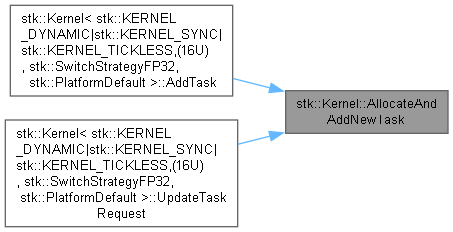
Referenced by stk::Kernel< stk::KERNEL_DYNAMIC|stk::KERNEL_SYNC|stk::KERNEL_TICKLESS,(16U), stk::SwitchStrategyFP32, stk::PlatformDefault >::AddTask(), and stk::Kernel< stk::KERNEL_DYNAMIC|stk::KERNEL_SYNC|stk::KERNEL_TICKLESS,(16U), stk::SwitchStrategyFP32, stk::PlatformDefault >::UpdateTaskRequest().

Here is the caller graph for this function:

◆ AllocateNewTask()

template<uint8_t TMode, uint32_t TSize, class TStrategy, class TPlatform>
KernelTask * stk::Kernel< TMode, TSize, TStrategy, TPlatform >::AllocateNewTask ( ITask * user_task)
inlineprotected

Allocate new instance of KernelTask.

Parameters
[in]user_taskUser task for which kernel task object is allocated.
Returns
Kernel task.

Definition at line 1355 of file stk.h.

1356 {
1357 // look for a free kernel task
1358 KernelTask *new_task = nullptr;
1359 for (size_t i = 0U; i < TASKS_MAX; ++i)
1360 {
1361 KernelTask *const task = &m_task_storage[i];
1362 if (task->IsBusy())
1363 {
1364 // avoid task collision
1365 STK_ASSERT(task->m_user != user_task);
1366
1367 // avoid stack collision
1368 STK_ASSERT(task->m_user->GetStack() != user_task->GetStack());
1369 }
1370 else
1371 if (new_task == nullptr)
1372 {
1373 new_task = task;
1374 #if defined(NDEBUG) && !defined(_STK_ASSERT_REDIRECT)
1375 break; // break if assertions are inactive and do not try to validate collision with existing tasks
1376 #endif
1377 }
1378 else
1379 {
1380 // noop, continue to the next slot
1381 }
1382 }
1383
1384 // if nullptr - exceeded max supported kernel task count, application design failure
1385 STK_ASSERT(new_task != nullptr);
1386
1387 new_task->Bind(&m_platform, user_task);
1388
1389 return new_task;
1390 }
static constexpr size_t TASKS_MAX
Maximum number of concurrently registered tasks. Fixed at compile time. Exceeding this limit in AddTa...
Definition stk.h:924

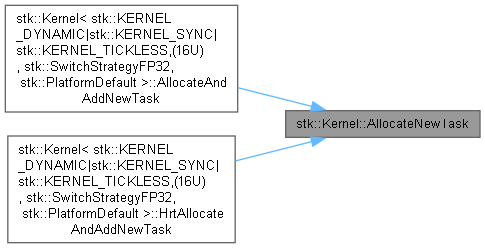
Referenced by stk::Kernel< stk::KERNEL_DYNAMIC|stk::KERNEL_SYNC|stk::KERNEL_TICKLESS,(16U), stk::SwitchStrategyFP32, stk::PlatformDefault >::AllocateAndAddNewTask(), and stk::Kernel< stk::KERNEL_DYNAMIC|stk::KERNEL_SYNC|stk::KERNEL_TICKLESS,(16U), stk::SwitchStrategyFP32, stk::PlatformDefault >::HrtAllocateAndAddNewTask().

Here is the caller graph for this function:

◆ EnumerateKernelTasks()

template<uint8_t TMode, uint32_t TSize, class TStrategy, class TPlatform>
size_t stk::Kernel< TMode, TSize, TStrategy, TPlatform >::EnumerateKernelTasks ( ArrayView< IKernelTask * > tasks)
inlineoverridevirtual

Enumerate kernel tasks.

Parameters
[in]tasksReference to the ArrayView of IKernelTask pointers.
Returns
Number of tasks in the array.

Implements stk::IKernel.

Definition at line 1177 of file stk.h.

1178 {
1179 size_t count = 0U;
1180 const size_t limit = Min(tasks.GetSize(), TASKS_MAX);
1181
1182 // avoid race with OnTick
1184
1185 for (size_t i = 0U; i < limit; ++i)
1186 {
1187 KernelTask *const task = &m_task_storage[i];
1188 if (task->IsBusy())
1189 {
1190 tasks[count++] = task;
1191 }
1192 }
1193
1194 return count;
1195 }
static constexpr T Min(T a, T b)
Compile-time minimum of two values.
Definition stk_defs.h:619

◆ EnumerateTasks()

template<uint8_t TMode, uint32_t TSize, class TStrategy, class TPlatform>
size_t stk::Kernel< TMode, TSize, TStrategy, TPlatform >::EnumerateTasks ( ArrayView< ITask * > user_tasks)
inlineoverridevirtual

Enumerate user tasks.

Parameters
[in]user_tasksReference to the ArrayView of ITask pointers.
Returns
Number of tasks in the array.

Implements stk::IKernel.

Definition at line 1201 of file stk.h.

1202 {
1203 size_t count = 0U;
1204 const size_t limit = Min(user_tasks.GetSize(), TASKS_MAX);
1205
1206 // avoid race with OnTick
1208
1209 for (size_t i = 0U; i < limit; ++i)
1210 {
1211 KernelTask *const task = &m_task_storage[i];
1212 if (task->IsBusy())
1213 {
1214 user_tasks[count++] = task->GetUserTask();
1215 }
1216 }
1217
1218 return count;
1219 }

◆ EnumerateTasksT()

template<size_t TMaxCount, typename TCallback>
size_t stk::IKernel::EnumerateTasksT ( TCallback && callback)
inlineinherited

Enumerate tasks, invoking a callback for each active task.

Template Parameters
TMaxCountMaximum number of tasks to enumerate. Should match or exceed the kernel's task capacity. Determines the size of the internal stack-allocated buffer (TMaxCount * sizeof(ITask*) bytes on the stack).
TCallbackCallable type, deduced automatically. Must satisfy: bool(ITask*)
Parameters
[in]callbackCallable invoked for each active task. Return true to continue, false to stop early.
Returns
Number of tasks visited (up to TMaxCount).
Warning
ISR-safe.

Example:

kernel.EnumerateTasks<_STK_KERNEL_TASKS_COUNT>([](ITask *t) {
Log(t->GetTraceName());
return true; // continue
});
Interface for a user task.
Definition stk_common.h:599

Definition at line 1235 of file stk_common.h.

1236 {
1237 STK_STATIC_ASSERT(TMaxCount > 0U);
1238
1239 ITask *tasks[TMaxCount] = {};
1240 size_t count = EnumerateTasks(ArrayView<ITask *>(tasks, TMaxCount));
1241 size_t i = 0U;
1242 bool fetch_next = true;
1243
1244 while ((i < count) && fetch_next)
1245 {
1246 fetch_next = callback(tasks[i]);
1247 ++i;
1248 }
1249
1250 return i;
1251 }
#define STK_STATIC_ASSERT(X)
Compile-time assertion. Produces a compilation error if X is false.
Definition stk_defs.h:446
virtual size_t EnumerateTasks(ArrayView< ITask * > user_tasks)=0
Enumerate user tasks.

References EnumerateTasks(), and STK_STATIC_ASSERT.

Here is the call graph for this function:

◆ FetchNextEvent()

template<uint8_t TMode, uint32_t TSize, class TStrategy, class TPlatform>
EFsmEvent stk::Kernel< TMode, TSize, TStrategy, TPlatform >::FetchNextEvent ( KernelTask *& next)
inlineprotected

Fetch next event for the FSM.

Parameters
[out]nextNext kernel task to which Kernel can switch.
Returns
FSM event.

Definition at line 2070 of file stk.h.

2071 {
2073
2074 // try getting next task for scheduling
2076
2077 // sleep-aware strategy returns nullptr if no active tasks available
2078 if (next != nullptr)
2079 {
2080 // strategy must provide active-only task
2081 STK_ASSERT(!next->IsSleeping());
2082
2083 // if was sleeping, process wake event first
2085 }
2086 // start sleeping
2087 else
2088 {
2090 {
2091 // if nullptr is returned then either strategy has all tasks sleeping or none left,
2092 // if KERNEL_DYNAMIC mode and no tasks left then exit from scheduling
2093 if (m_strategy.GetSize() == 0U)
2094 {
2095 next = nullptr;
2097 }
2098 }
2099 }
2100
2101 return type;
2102 }
EFsmEvent
Finite-state machine (FSM) event. Computed by FetchNextEvent() each tick based on strategy output and...
Definition stk.h:1295
static __stk_forceinline TTargetType * ListEntryToParent(TSourceType *const lentry)
Safely casts an intrusive list entry to its concrete parent container object type.

Referenced by stk::Kernel< stk::KERNEL_DYNAMIC|stk::KERNEL_SYNC|stk::KERNEL_TICKLESS,(16U), stk::SwitchStrategyFP32, stk::PlatformDefault >::GetNewFsmState().

Here is the caller graph for this function:

◆ FindTaskBySP()

template<uint8_t TMode, uint32_t TSize, class TStrategy, class TPlatform>
KernelTask * stk::Kernel< TMode, TSize, TStrategy, TPlatform >::FindTaskBySP ( Word SP)
inlineprotected

Find kernel task for a Stack Pointer (SP).

Parameters
[in]SPStack pointer.
Returns
Kernel task.

Definition at line 1505 of file stk.h.

1506 {
1507 STK_ASSERT(m_task_now != nullptr);
1508
1509 KernelTask *found_task = nullptr;
1510
1511 if (m_task_now->IsMemoryOfSP(SP))
1512 {
1514 }
1515 else
1516 {
1517 for (size_t i = 0U; i < TASKS_MAX; ++i)
1518 {
1519 KernelTask *const task = &m_task_storage[i];
1520
1521 // skip finished tasks (applicable only for KERNEL_DYNAMIC mode)
1523 {
1524 if (!task->IsBusy())
1525 {
1526 continue;
1527 }
1528 }
1529
1530 if (task->IsMemoryOfSP(SP))
1531 {
1532 found_task = task;
1533 break;
1534 }
1535 }
1536 }
1537
1538 return found_task;
1539 }

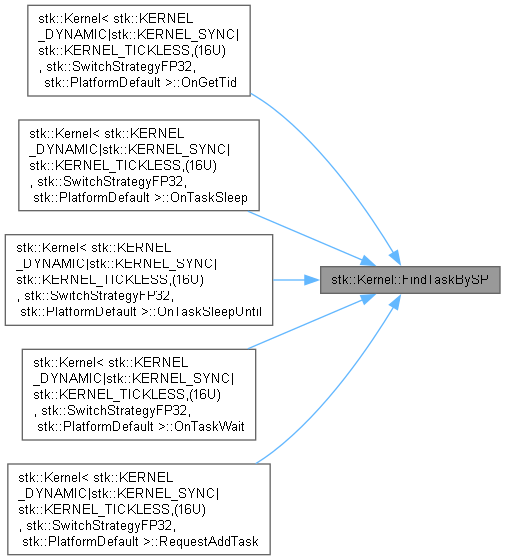
Referenced by stk::Kernel< stk::KERNEL_DYNAMIC|stk::KERNEL_SYNC|stk::KERNEL_TICKLESS,(16U), stk::SwitchStrategyFP32, stk::PlatformDefault >::OnGetTid(), stk::Kernel< stk::KERNEL_DYNAMIC|stk::KERNEL_SYNC|stk::KERNEL_TICKLESS,(16U), stk::SwitchStrategyFP32, stk::PlatformDefault >::OnTaskSleep(), stk::Kernel< stk::KERNEL_DYNAMIC|stk::KERNEL_SYNC|stk::KERNEL_TICKLESS,(16U), stk::SwitchStrategyFP32, stk::PlatformDefault >::OnTaskSleepUntil(), stk::Kernel< stk::KERNEL_DYNAMIC|stk::KERNEL_SYNC|stk::KERNEL_TICKLESS,(16U), stk::SwitchStrategyFP32, stk::PlatformDefault >::OnTaskWait(), and stk::Kernel< stk::KERNEL_DYNAMIC|stk::KERNEL_SYNC|stk::KERNEL_TICKLESS,(16U), stk::SwitchStrategyFP32, stk::PlatformDefault >::RequestAddTask().

Here is the caller graph for this function:

◆ FindTaskByStack()

template<uint8_t TMode, uint32_t TSize, class TStrategy, class TPlatform>
KernelTask * stk::Kernel< TMode, TSize, TStrategy, TPlatform >::FindTaskByStack ( const Stack * stack)
inlineprotected

Find kernel task by the bound Stack instance.

Parameters
[in]stackStack.
Returns
Kernel task.

Definition at line 1484 of file stk.h.

1485 {
1486 KernelTask *found_task = nullptr;
1487
1488 for (size_t i = 0U; i < TASKS_MAX; ++i)
1489 {
1490 KernelTask *const task = &m_task_storage[i];
1491 if (task->GetUserStackPtr() == stack)
1492 {
1493 found_task = task;
1494 break;
1495 }
1496 }
1497
1498 return found_task;
1499 }

Referenced by stk::Kernel< stk::KERNEL_DYNAMIC|stk::KERNEL_SYNC|stk::KERNEL_TICKLESS,(16U), stk::SwitchStrategyFP32, stk::PlatformDefault >::OnTaskExit().

Here is the caller graph for this function:

◆ FindTaskByUserTask()

template<uint8_t TMode, uint32_t TSize, class TStrategy, class TPlatform>
KernelTask * stk::Kernel< TMode, TSize, TStrategy, TPlatform >::FindTaskByUserTask ( const ITask * user_task)
inlineprotected

Find kernel task by the bound ITask instance.

Parameters
[in]user_taskUser task.
Returns
Kernel task.

Definition at line 1463 of file stk.h.

1464 {
1465 KernelTask *found_task = nullptr;
1466
1467 for (size_t i = 0U; i < TASKS_MAX; ++i)
1468 {
1469 KernelTask *const task = &m_task_storage[i];
1470 if (task->GetUserTask() == user_task)
1471 {
1472 found_task = task;
1473 break;
1474 }
1475 }
1476
1477 return found_task;
1478 }

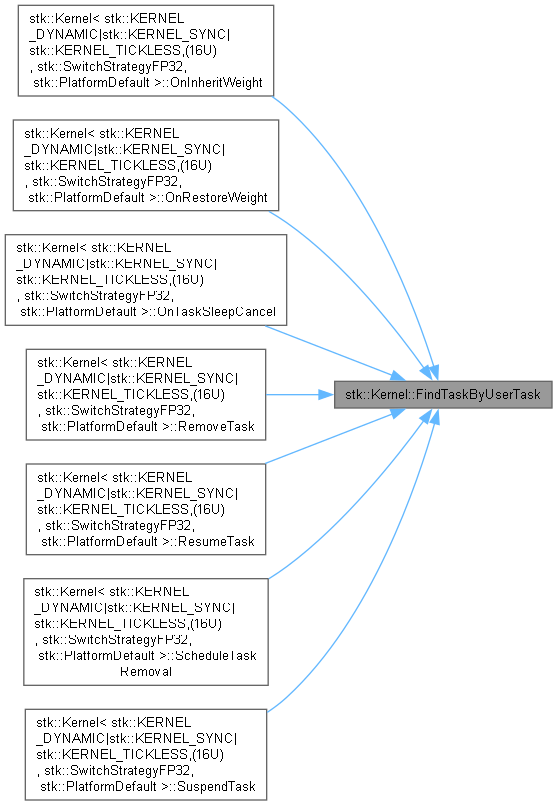
Referenced by stk::Kernel< stk::KERNEL_DYNAMIC|stk::KERNEL_SYNC|stk::KERNEL_TICKLESS,(16U), stk::SwitchStrategyFP32, stk::PlatformDefault >::OnInheritWeight(), stk::Kernel< stk::KERNEL_DYNAMIC|stk::KERNEL_SYNC|stk::KERNEL_TICKLESS,(16U), stk::SwitchStrategyFP32, stk::PlatformDefault >::OnRestoreWeight(), stk::Kernel< stk::KERNEL_DYNAMIC|stk::KERNEL_SYNC|stk::KERNEL_TICKLESS,(16U), stk::SwitchStrategyFP32, stk::PlatformDefault >::OnTaskSleepCancel(), stk::Kernel< stk::KERNEL_DYNAMIC|stk::KERNEL_SYNC|stk::KERNEL_TICKLESS,(16U), stk::SwitchStrategyFP32, stk::PlatformDefault >::RemoveTask(), stk::Kernel< stk::KERNEL_DYNAMIC|stk::KERNEL_SYNC|stk::KERNEL_TICKLESS,(16U), stk::SwitchStrategyFP32, stk::PlatformDefault >::ResumeTask(), stk::Kernel< stk::KERNEL_DYNAMIC|stk::KERNEL_SYNC|stk::KERNEL_TICKLESS,(16U), stk::SwitchStrategyFP32, stk::PlatformDefault >::ScheduleTaskRemoval(), and stk::Kernel< stk::KERNEL_DYNAMIC|stk::KERNEL_SYNC|stk::KERNEL_TICKLESS,(16U), stk::SwitchStrategyFP32, stk::PlatformDefault >::SuspendTask().

Here is the caller graph for this function:

◆ GetNewFsmState()

template<uint8_t TMode, uint32_t TSize, class TStrategy, class TPlatform>
EFsmState stk::Kernel< TMode, TSize, TStrategy, TPlatform >::GetNewFsmState ( KernelTask *& next)
inlineprotected

Get new FSM state.

Parameters
[out]nextNext kernel task to which Kernel can switch.
Returns
FSM state.

Definition at line 2111 of file stk.h.

2112 {
2115 }
static bool IsValidFsmState(EFsmState state)
Check if FSM state is valid.
Definition stk.h:1313
const EFsmState m_fsm[FSM_STATE_MAX][FSM_EVENT_MAX]
Definition stk.h:2431
EFsmEvent FetchNextEvent(KernelTask *&next)
Fetch next event for the FSM.
Definition stk.h:2070

Referenced by stk::Kernel< stk::KERNEL_DYNAMIC|stk::KERNEL_SYNC|stk::KERNEL_TICKLESS,(16U), stk::SwitchStrategyFP32, stk::PlatformDefault >::OnStart(), and stk::Kernel< stk::KERNEL_DYNAMIC|stk::KERNEL_SYNC|stk::KERNEL_TICKLESS,(16U), stk::SwitchStrategyFP32, stk::PlatformDefault >::UpdateFsmState().

Here is the caller graph for this function:

◆ GetPlatform()

template<uint8_t TMode, uint32_t TSize, class TStrategy, class TPlatform>
IPlatform * stk::Kernel< TMode, TSize, TStrategy, TPlatform >::GetPlatform ( )
inlineoverridevirtual

Get platform driver instance owned by this kernel.

Returns
Pointer to the internal TPlatform cast to IPlatform*.

Implements stk::IKernel.

Definition at line 1264 of file stk.h.

1264{ return &m_platform; }

◆ GetState()

template<uint8_t TMode, uint32_t TSize, class TStrategy, class TPlatform>
EKernelState stk::Kernel< TMode, TSize, TStrategy, TPlatform >::GetState ( ) const
inlineoverridevirtual

Get kernel state.

Implements stk::IKernel.

Definition at line 1273 of file stk.h.

1273{ return m_kstate; }

◆ GetSwitchStrategy()

template<uint8_t TMode, uint32_t TSize, class TStrategy, class TPlatform>
ITaskSwitchStrategy * stk::Kernel< TMode, TSize, TStrategy, TPlatform >::GetSwitchStrategy ( )
inlineoverridevirtual

Get task-switching strategy instance owned by this kernel.

Returns
Pointer to the internal TStrategy cast to ITaskSwitchStrategy*.

Implements stk::IKernel.

Definition at line 1269 of file stk.h.

1269{ return &m_strategy; }

◆ HrtAllocateAndAddNewTask()

template<uint8_t TMode, uint32_t TSize, class TStrategy, class TPlatform>
void stk::Kernel< TMode, TSize, TStrategy, TPlatform >::HrtAllocateAndAddNewTask ( ITask * user_task,
Timeout periodicity_tc,
Timeout deadline_tc,
Timeout start_delay_tc )
inlineprotected

Allocate new instance of KernelTask and add it into the HRT scheduling process.

Note
Related to stk::KERNEL_HRT mode only.
Parameters
[in]user_taskUser task for which kernel task object is allocated.
[in]periodicity_tcPeriodicity time at which task is scheduled (ticks).
[in]deadline_tcDeadline time within which a task must complete its work (ticks).
[in]start_delay_tcInitial start delay for the task (ticks).

Definition at line 1425 of file stk.h.

1426 {
1428 STK_ASSERT(task != nullptr);
1429
1431
1433 }

Referenced by stk::Kernel< stk::KERNEL_DYNAMIC|stk::KERNEL_SYNC|stk::KERNEL_TICKLESS,(16U), stk::SwitchStrategyFP32, stk::PlatformDefault >::AddTask().

Here is the caller graph for this function:

◆ Initialize()

template<uint8_t TMode, uint32_t TSize, class TStrategy, class TPlatform>
void stk::Kernel< TMode, TSize, TStrategy, TPlatform >::Initialize ( uint32_t resolution_us = PERIODICITY_DEFAULT)
inlineoverridevirtual

Initialize kernel.

Parameters
[in]resolution_usResolution of the system tick (SysTick) timer in microseconds. Defaults to PERIODICITY_DEFAULT (1000 µs = 1 ms).
Note
Must be called before AddTask() and Start().
If running on an STM32 device with HAL driver or on QEMU, do not change the default resolution (PERIODICITY_DEFAULT). STM32's HAL expects 1 millisecond resolution and QEMU does not have enough resolution on Windows to operate correctly at sub-millisecond resolution.
Kernel must be in STATE_INACTIVE state.

Implements stk::IKernel.

Definition at line 966 of file stk.h.

967 {
971
972 // reinitialize key state variables
973 m_task_now = nullptr;
976
977 // exit trap is required only for KERNEL_DYNAMIC mode
980 {
981 exit_trap = &m_exit_trap[0].stack;
982 }
983 else
984 {
985 exit_trap = nullptr;
986 }
987
988 m_service.Initialize(this);
989 m_platform.Initialize(this, &m_service, resolution_us, exit_trap);
990
991 // now ready to Start()
993 }
KernelService m_service
Kernel service singleton exposed to running tasks via IKernelService::GetInstance().
Definition stk.h:2419

◆ InitTraps()

template<uint8_t TMode, uint32_t TSize, class TStrategy, class TPlatform>
void stk::Kernel< TMode, TSize, TStrategy, TPlatform >::InitTraps ( )
inlineprotected

Initialize stack of the traps.

Definition at line 1321 of file stk.h.

1322 {
1323 // init stack for a Sleep trap
1324 {
1326
1328 sleep.stack.access_mode = ACCESS_PRIVILEGED;
1329 #if STK_NEED_TASK_ID
1330 sleep.stack.tid = SYS_TASK_ID_SLEEP;
1331 #endif
1332
1333 STK_UNUSED(m_platform.InitStack(STACK_SLEEP_TRAP, &sleep.stack, &wrapper, nullptr));
1334 }
1335
1336 // init stack for an Exit trap
1338 {
1340
1342 exit.stack.access_mode = ACCESS_PRIVILEGED;
1343 #if STK_NEED_TASK_ID
1344 exit.stack.tid = SYS_TASK_ID_EXIT;
1345 #endif
1346
1347 STK_UNUSED(m_platform.InitStack(STACK_EXIT_TRAP, &exit.stack, &wrapper, nullptr));
1348 }
1349 }
StackMemoryWrapper< STACK_SIZE_MIN > ExitTrapStackMemory
Stack memory wrapper type for the exit trap.
Definition stk.h:97
StackMemoryWrapper<((32U))> SleepTrapStackMemory
Stack memory wrapper type for the sleep trap.
Definition stk.h:91
Storage bundle for the sleep trap: a Stack descriptor paired with its backing memory.
Definition stk.h:2389
Storage bundle for the exit trap: a Stack descriptor paired with its backing memory.
Definition stk.h:2405

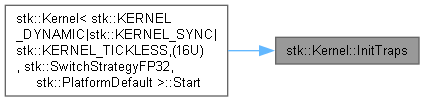
Referenced by stk::Kernel< stk::KERNEL_DYNAMIC|stk::KERNEL_SYNC|stk::KERNEL_TICKLESS,(16U), stk::SwitchStrategyFP32, stk::PlatformDefault >::Start().

Here is the caller graph for this function:

◆ IsDynamicMode()

template<uint8_t TMode, uint32_t TSize, class TStrategy, class TPlatform>
constexpr bool stk::Kernel< TMode, TSize, TStrategy, TPlatform >::IsDynamicMode ( )
inlinestaticconstexprprotected

Definition at line 2348 of file stk.h.

2348{ return ((TMode & KERNEL_DYNAMIC) != 0U); }

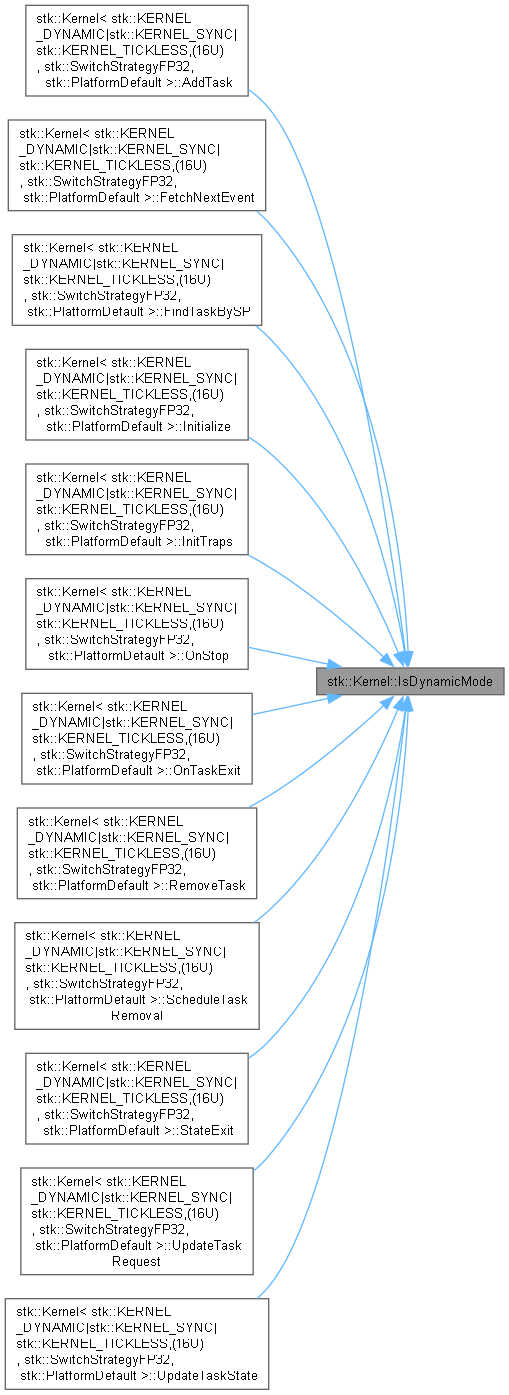
Referenced by stk::Kernel< stk::KERNEL_DYNAMIC|stk::KERNEL_SYNC|stk::KERNEL_TICKLESS,(16U), stk::SwitchStrategyFP32, stk::PlatformDefault >::AddTask(), stk::Kernel< stk::KERNEL_DYNAMIC|stk::KERNEL_SYNC|stk::KERNEL_TICKLESS,(16U), stk::SwitchStrategyFP32, stk::PlatformDefault >::FetchNextEvent(), stk::Kernel< stk::KERNEL_DYNAMIC|stk::KERNEL_SYNC|stk::KERNEL_TICKLESS,(16U), stk::SwitchStrategyFP32, stk::PlatformDefault >::FindTaskBySP(), stk::Kernel< stk::KERNEL_DYNAMIC|stk::KERNEL_SYNC|stk::KERNEL_TICKLESS,(16U), stk::SwitchStrategyFP32, stk::PlatformDefault >::Initialize(), stk::Kernel< stk::KERNEL_DYNAMIC|stk::KERNEL_SYNC|stk::KERNEL_TICKLESS,(16U), stk::SwitchStrategyFP32, stk::PlatformDefault >::InitTraps(), stk::Kernel< stk::KERNEL_DYNAMIC|stk::KERNEL_SYNC|stk::KERNEL_TICKLESS,(16U), stk::SwitchStrategyFP32, stk::PlatformDefault >::OnStop(), stk::Kernel< stk::KERNEL_DYNAMIC|stk::KERNEL_SYNC|stk::KERNEL_TICKLESS,(16U), stk::SwitchStrategyFP32, stk::PlatformDefault >::OnTaskExit(), stk::Kernel< stk::KERNEL_DYNAMIC|stk::KERNEL_SYNC|stk::KERNEL_TICKLESS,(16U), stk::SwitchStrategyFP32, stk::PlatformDefault >::RemoveTask(), stk::Kernel< stk::KERNEL_DYNAMIC|stk::KERNEL_SYNC|stk::KERNEL_TICKLESS,(16U), stk::SwitchStrategyFP32, stk::PlatformDefault >::ScheduleTaskRemoval(), stk::Kernel< stk::KERNEL_DYNAMIC|stk::KERNEL_SYNC|stk::KERNEL_TICKLESS,(16U), stk::SwitchStrategyFP32, stk::PlatformDefault >::StateExit(), stk::Kernel< stk::KERNEL_DYNAMIC|stk::KERNEL_SYNC|stk::KERNEL_TICKLESS,(16U), stk::SwitchStrategyFP32, stk::PlatformDefault >::UpdateTaskRequest(), and stk::Kernel< stk::KERNEL_DYNAMIC|stk::KERNEL_SYNC|stk::KERNEL_TICKLESS,(16U), stk::SwitchStrategyFP32, stk::PlatformDefault >::UpdateTaskState().

Here is the caller graph for this function:

◆ IsHrtMode()

template<uint8_t TMode, uint32_t TSize, class TStrategy, class TPlatform>
constexpr bool stk::Kernel< TMode, TSize, TStrategy, TPlatform >::IsHrtMode ( )
inlinestaticconstexprprotected

Definition at line 2349 of file stk.h.

2349{ return ((TMode & KERNEL_HRT) != 0U); }

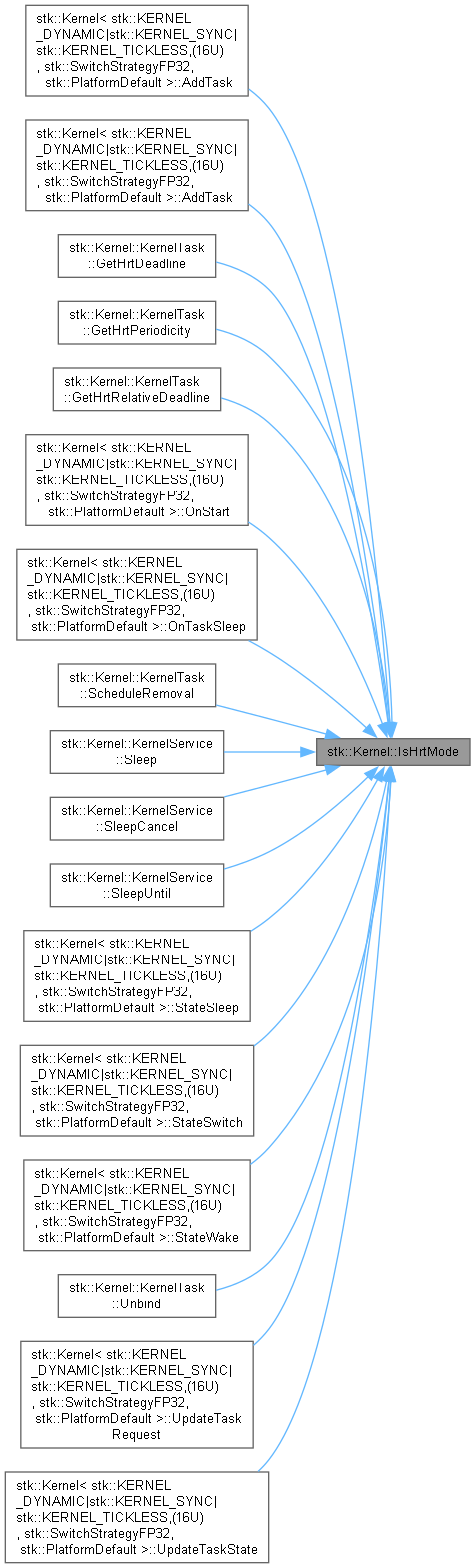
Referenced by stk::Kernel< stk::KERNEL_DYNAMIC|stk::KERNEL_SYNC|stk::KERNEL_TICKLESS,(16U), stk::SwitchStrategyFP32, stk::PlatformDefault >::AddTask(), stk::Kernel< stk::KERNEL_DYNAMIC|stk::KERNEL_SYNC|stk::KERNEL_TICKLESS,(16U), stk::SwitchStrategyFP32, stk::PlatformDefault >::AddTask(), stk::Kernel< TMode, TSize, TStrategy, TPlatform >::KernelTask::GetHrtDeadline(), stk::Kernel< TMode, TSize, TStrategy, TPlatform >::KernelTask::GetHrtPeriodicity(), stk::Kernel< TMode, TSize, TStrategy, TPlatform >::KernelTask::GetHrtRelativeDeadline(), stk::Kernel< stk::KERNEL_DYNAMIC|stk::KERNEL_SYNC|stk::KERNEL_TICKLESS,(16U), stk::SwitchStrategyFP32, stk::PlatformDefault >::OnStart(), stk::Kernel< stk::KERNEL_DYNAMIC|stk::KERNEL_SYNC|stk::KERNEL_TICKLESS,(16U), stk::SwitchStrategyFP32, stk::PlatformDefault >::OnTaskSleep(), stk::Kernel< TMode, TSize, TStrategy, TPlatform >::KernelTask::ScheduleRemoval(), stk::Kernel< TMode, TSize, TStrategy, TPlatform >::KernelService::Sleep(), stk::Kernel< TMode, TSize, TStrategy, TPlatform >::KernelService::SleepCancel(), stk::Kernel< TMode, TSize, TStrategy, TPlatform >::KernelService::SleepUntil(), stk::Kernel< stk::KERNEL_DYNAMIC|stk::KERNEL_SYNC|stk::KERNEL_TICKLESS,(16U), stk::SwitchStrategyFP32, stk::PlatformDefault >::StateSleep(), stk::Kernel< stk::KERNEL_DYNAMIC|stk::KERNEL_SYNC|stk::KERNEL_TICKLESS,(16U), stk::SwitchStrategyFP32, stk::PlatformDefault >::StateSwitch(), stk::Kernel< stk::KERNEL_DYNAMIC|stk::KERNEL_SYNC|stk::KERNEL_TICKLESS,(16U), stk::SwitchStrategyFP32, stk::PlatformDefault >::StateWake(), stk::Kernel< TMode, TSize, TStrategy, TPlatform >::KernelTask::Unbind(), stk::Kernel< stk::KERNEL_DYNAMIC|stk::KERNEL_SYNC|stk::KERNEL_TICKLESS,(16U), stk::SwitchStrategyFP32, stk::PlatformDefault >::UpdateTaskRequest(), and stk::Kernel< stk::KERNEL_DYNAMIC|stk::KERNEL_SYNC|stk::KERNEL_TICKLESS,(16U), stk::SwitchStrategyFP32, stk::PlatformDefault >::UpdateTaskState().

Here is the caller graph for this function:

◆ IsInitialized()

◆ IsStarted()

◆ IsStaticMode()

template<uint8_t TMode, uint32_t TSize, class TStrategy, class TPlatform>
constexpr bool stk::Kernel< TMode, TSize, TStrategy, TPlatform >::IsStaticMode ( )
inlinestaticconstexprprotected

Definition at line 2347 of file stk.h.

2347{ return ((TMode & KERNEL_STATIC) != 0U); }

◆ IsSyncMode()

◆ IsTicklessMode()

template<uint8_t TMode, uint32_t TSize, class TStrategy, class TPlatform>
constexpr bool stk::Kernel< TMode, TSize, TStrategy, TPlatform >::IsTicklessMode ( )
inlinestaticconstexprprotected

◆ IsValidFsmState()

template<uint8_t TMode, uint32_t TSize, class TStrategy, class TPlatform>
bool stk::Kernel< TMode, TSize, TStrategy, TPlatform >::IsValidFsmState ( EFsmState state)
inlinestaticprotected

Check if FSM state is valid.

Definition at line 1313 of file stk.h.

1314 {
1315 return (state > FSM_STATE_NONE) &&
1316 (state < FSM_STATE_MAX);
1317 }

Referenced by stk::Kernel< stk::KERNEL_DYNAMIC|stk::KERNEL_SYNC|stk::KERNEL_TICKLESS,(16U), stk::SwitchStrategyFP32, stk::PlatformDefault >::GetNewFsmState().

Here is the caller graph for this function:

◆ OnGetTid()

template<uint8_t TMode, uint32_t TSize, class TStrategy, class TPlatform>
TId stk::Kernel< TMode, TSize, TStrategy, TPlatform >::OnGetTid ( Word caller_SP)
inlineoverrideprotectedvirtual

Called from the Thread process when for getting task/thread id of the process.

Parameters
[in]caller_SPValue of Stack Pointer (SP) register (for locating the calling process inside the kernel).
Returns
Task/thread id of the process (returns always valid TId belonging to a task).

Implements stk::IPlatform::IEventHandler.

Definition at line 1826 of file stk.h.

1827 {
1829 STK_ASSERT(task != nullptr);
1830
1831 return task->GetTid();
1832 }
KernelTask * FindTaskBySP(Word SP)
Find kernel task for a Stack Pointer (SP).
Definition stk.h:1505

◆ OnInheritWeight()

template<uint8_t TMode, uint32_t TSize, class TStrategy, class TPlatform>
void stk::Kernel< TMode, TSize, TStrategy, TPlatform >::OnInheritWeight ( TId tid,
Weight weight )
inlineprotected

Definition at line 1859 of file stk.h.

1860 {
1863
1864 if (weight != NO_WEIGHT)
1865 {
1867 STK_ASSERT(task != nullptr);
1868
1869 const Weight prev_weight = task->GetWeight();
1870
1871 if (prev_weight < weight)
1872 {
1873 task->SetCurrentWeight(weight);
1874 m_strategy.OnTaskWeightChange(task, prev_weight);
1875 }
1876 }
1877 }
static constexpr ITask * GetUserTaskFromTid(TId task_id) noexcept
Get task instance from its identifier.
Definition stk_arch.h:526
KernelTask * FindTaskByUserTask(const ITask *user_task)
Find kernel task by the bound ITask instance.
Definition stk.h:1463

◆ OnRestoreWeight()

template<uint8_t TMode, uint32_t TSize, class TStrategy, class TPlatform>
void stk::Kernel< TMode, TSize, TStrategy, TPlatform >::OnRestoreWeight ( TId tid,
ISyncObject * sobj )
inlineprotected

Definition at line 1879 of file stk.h.

1880 {
1883
1885 STK_ASSERT(task != nullptr);
1886
1887 const Weight prev_weight = task->GetWeight();
1888
1889 // restore to original or boost from wait objects
1890 task->SetCurrentWeight(sobj != nullptr ? sobj->FindWeightHigherThan(task->GetWeight()) : NO_WEIGHT);
1891
1892 m_strategy.OnTaskWeightChange(task, prev_weight);
1893 }

◆ OnStart()

template<uint8_t TMode, uint32_t TSize, class TStrategy, class TPlatform>
void stk::Kernel< TMode, TSize, TStrategy, TPlatform >::OnStart ( Stack *& active)
inlineoverrideprotectedvirtual

Called by platform driver immediately after a scheduler start (first tick).

Parameters
[out]activeSet to the stack of the first task to run, or to the sleep-trap stack if all tasks are initially sleeping.
Note
Delivers initial OnTaskSleep notifications to sleep-aware strategies for any tasks that were added in a sleeping state before Start() was called.
Selects the first runnable task via GetNewFsmState() and transitions the kernel to STATE_RUNNING.
If STK_SEGGER_SYSVIEW is enabled, emits a task-start trace event for the first task.
Warning
At least one task must have been added via AddTask(); asserts if the strategy pool is empty.

Implements stk::IPlatform::IEventHandler.

Definition at line 1570 of file stk.h.

1571 {
1572 STK_ASSERT(m_strategy.GetSize() != 0);
1573
1574 // iterate tasks and generate OnTaskSleep for a strategy for all initially sleeping tasks
1576 {
1577 for (size_t i = 0U; i < TASKS_MAX; ++i)
1578 {
1579 KernelTask *const task = &m_task_storage[i];
1580
1581 if (task->IsSleeping())
1582 {
1583 if ((task->m_state & KernelTask::STATE_SLEEP_PENDING) != 0U)
1584 {
1586
1587 // notify strategy that task is sleeping
1588 m_strategy.OnTaskSleep(task);
1589 }
1590 }
1591 }
1592 }
1593
1594 // get initial state and first task
1595 {
1597
1598 KernelTask *next = nullptr;
1600
1601 // expecting only SLEEPING or SWITCHING states
1603
1605 {
1606 m_task_now = next;
1607 active = next->GetUserStackPtr();
1608
1610 {
1611 next->HrtOnSwitchedIn();
1612 }
1613 }
1614 else
1616 {
1618 active = &m_sleep_trap[0].stack;
1619 }
1620 else
1621 {
1622 // unexpected state
1624 }
1625 }
1626
1627 // is in running state
1629
1630 #if STK_SEGGER_SYSVIEW
1632 #endif
1633 }
static __stk_forceinline void STK_KERNEL_PANIC(stk::EKernelPanicId id)
Called when the kernel detects an unrecoverable internal fault.
Definition stk_arch.h:75
EFsmState GetNewFsmState(KernelTask *&next)
Get new FSM state.
Definition stk.h:2111
@ STATE_SLEEP_PENDING
Task called Sleep/SleepUntil/Yield; strategy's OnTaskSleep() will be invoked on the next tick (sleep-...
Definition stk.h:132

◆ OnStop()

template<uint8_t TMode, uint32_t TSize, class TStrategy, class TPlatform>
void stk::Kernel< TMode, TSize, TStrategy, TPlatform >::OnStop ( )
inlineoverrideprotectedvirtual

Called by the platform driver after a scheduler stop (all tasks have exited).

Note
KERNEL_DYNAMIC mode only: resets FSM to FSM_STATE_NONE and transitions kernel back to STATE_READY so Start() may be called again.
Has no effect in KERNEL_STATIC mode (static kernels never stop).

Implements stk::IPlatform::IEventHandler.

Definition at line 1640 of file stk.h.

1641 {
1643 {
1645
1646 // is in stopped state, i.e. is ready to Start() again
1648 }
1649 }

◆ OnSuspend()

template<uint8_t TMode, uint32_t TSize, class TStrategy, class TPlatform>
void stk::Kernel< TMode, TSize, TStrategy, TPlatform >::OnSuspend ( bool suspended)
inlineoverrideprotectedvirtual

Called from the Thread process to suspend scheduling.

Parameters
[in]suspendedtrue if scheduling was successfully suspended, false otherwise.

Implements stk::IPlatform::IEventHandler.

Definition at line 1834 of file stk.h.

1835 {
1836 // toggle kernel state
1837 if (suspended)
1838 {
1839 if (m_kstate == KSTATE_RUNNING)
1840 {
1842 }
1843 }
1844 else
1845 {
1846 if (m_kstate == KSTATE_SUSPENDED)
1847 {
1849 }
1850 }
1851
1852 // force yield for a currently active task
1853 if (!m_task_now->IsSleeping())
1854 {
1855 m_task_now->ScheduleSleep(YIELD_TICKS);
1856 }
1857 }
static constexpr Timeout YIELD_TICKS
Ticks to yield.
Definition stk.h:1309

◆ OnTaskExit()

template<uint8_t TMode, uint32_t TSize, class TStrategy, class TPlatform>
void stk::Kernel< TMode, TSize, TStrategy, TPlatform >::OnTaskExit ( Stack * stack)
inlineoverrideprotectedvirtual

Called from the Thread process when task finished (its Run function exited by return).

Parameters
[out]stackStack of the exited task.

Implements stk::IPlatform::IEventHandler.

Definition at line 1767 of file stk.h.

1768 {
1770 {
1772 STK_ASSERT(task != nullptr);
1773
1774 // notify kernel to execute removal
1775 task->ScheduleRemoval();
1776 }
1777 else
1778 {
1779 // kernel operating mode must be KERNEL_DYNAMIC for tasks to be able to exit
1781 }
1782 }
KernelTask * FindTaskByStack(const Stack *stack)
Find kernel task by the bound Stack instance.
Definition stk.h:1484

◆ OnTaskSleep()

template<uint8_t TMode, uint32_t TSize, class TStrategy, class TPlatform>
void stk::Kernel< TMode, TSize, TStrategy, TPlatform >::OnTaskSleep ( Word caller_SP,
Timeout ticks )
inlineoverrideprotectedvirtual

Called by Thread process (via IKernelService::Sleep) for exclusion of the calling process from scheduling (sleeping).

Parameters
[in]caller_SPValue of Stack Pointer (SP) register (for locating the calling process inside the kernel).
[in]ticksTime to sleep (ticks).

Implements stk::IPlatform::IEventHandler.

Definition at line 1699 of file stk.h.

1700 {
1702 STK_ASSERT(task != nullptr);
1703
1704 // make change to HRT state and sleep time atomic
1705 {
1707
1709 {
1710 task->HrtOnWorkCompleted();
1711 }
1712
1713 if (ticks > 0)
1714 {
1715 task->ScheduleSleep(ticks);
1716 }
1717 }
1718
1719 // note: we do not spin long here, kernel will switch this task out from scheduling on the next tick
1720 task->BusyWaitWhileSleeping();
1721 }

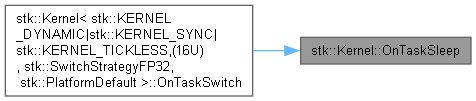
Referenced by stk::Kernel< stk::KERNEL_DYNAMIC|stk::KERNEL_SYNC|stk::KERNEL_TICKLESS,(16U), stk::SwitchStrategyFP32, stk::PlatformDefault >::OnTaskSwitch().

Here is the caller graph for this function:

◆ OnTaskSleepCancel()

template<uint8_t TMode, uint32_t TSize, class TStrategy, class TPlatform>
void stk::Kernel< TMode, TSize, TStrategy, TPlatform >::OnTaskSleepCancel ( TId task_id)
inlineprotected

Definition at line 1753 of file stk.h.

1754 {
1756 if (task != nullptr)
1757 {
1759
1760 if (task->IsSleeping())
1761 {
1762 task->Wake();
1763 }
1764 }
1765 }

◆ OnTaskSleepUntil()

template<uint8_t TMode, uint32_t TSize, class TStrategy, class TPlatform>
bool stk::Kernel< TMode, TSize, TStrategy, TPlatform >::OnTaskSleepUntil ( Word caller_SP,
Ticks timestamp )
inlineoverrideprotectedvirtual

Called by Thread process (via IKernelService::SleepUntil) for exclusion of the calling process from scheduling (sleeping).

Parameters
[in]caller_SPValue of Stack Pointer (SP) register (for locating the calling process inside the kernel).
[in]timestampAbsolute timestamp (ticks).
Returns
True if sleep succeeded, false otherwise.

Implements stk::IPlatform::IEventHandler.

Definition at line 1723 of file stk.h.

1724 {
1726 STK_ASSERT(task != nullptr);
1727
1728 bool result = true;
1729
1730 // make change to HRT state and sleep time atomic
1731 {
1733
1734 // calculate signed delta (handles wrap-around correctly)
1735 const Ticks delta = timestamp - m_service.m_ticks;
1736
1737 if (delta > 0)
1738 {
1740 task->ScheduleSleep(static_cast<Timeout>(Min(delta, infinite_ticks)));
1741 }
1742 else
1743 {
1744 result = false; // deadline already hit or passed
1745 }
1746 }
1747
1748 // note: we do not spin long here, kernel will switch this task out from scheduling on the next tick
1749 task->BusyWaitWhileSleeping();
1750 return result;
1751 }

◆ OnTaskSwitch()

template<uint8_t TMode, uint32_t TSize, class TStrategy, class TPlatform>
void stk::Kernel< TMode, TSize, TStrategy, TPlatform >::OnTaskSwitch ( Word caller_SP)
inlineoverrideprotectedvirtual

Called by Thread process (via IKernelService::SwitchToNext) to switch to a next task.

Parameters
[in]caller_SPValue of Stack Pointer (SP) register (for locating the calling process inside the kernel).

Implements stk::IPlatform::IEventHandler.

Definition at line 1694 of file stk.h.

1695 {
1697 }
void OnTaskSleep(Word caller_SP, Timeout ticks) override
Called by Thread process (via IKernelService::Sleep) for exclusion of the calling process from schedu...
Definition stk.h:1699

◆ OnTaskWait()

template<uint8_t TMode, uint32_t TSize, class TStrategy, class TPlatform>
IWaitObject * stk::Kernel< TMode, TSize, TStrategy, TPlatform >::OnTaskWait ( Word caller_SP,
ISyncObject * sync_obj,
IMutex * mutex,
Timeout timeout )
inlineoverrideprotectedvirtual

Called from the Thread process when task needs to wait.

Parameters
[in]caller_SPValue of Stack Pointer (SP) register (for locating the calling process inside the kernel).
[in]sync_objISyncObject instance (passed by Wait).
[in]mutexIMutex instance (passed by Wait).
[in]timeoutTime to sleep (ticks).

Implements stk::IPlatform::IEventHandler.

Definition at line 1784 of file stk.h.

1785 {
1787 {
1788 STK_ASSERT(timeout != 0); // API contract: caller must not be in ISR
1789 STK_ASSERT(sync_obj != nullptr); // API contract: ISyncObject instance must be provided
1790 STK_ASSERT(mutex != nullptr); // API contract: IMutex instance must be provided
1791 STK_ASSERT((sync_obj->GetHead() == nullptr) || (sync_obj->GetHead() == &m_sync_list[0]));
1792
1794 STK_ASSERT(task != nullptr);
1795
1796 // configure waiting
1797 task->m_wait_obj->SetupWait(sync_obj, timeout);
1798
1799 // register ISyncObject if not yet
1800 if (sync_obj->GetHead() == nullptr)
1801 {
1802 m_sync_list->LinkBack(sync_obj);
1803 }
1804
1805 // start sleeping infinitely, we rely on a Wake call via WaitObject
1806 task->ScheduleSleep(WAIT_INFINITE);
1807
1808 // unlock mutex locked externally, so that we could wait in a busy-waiting loop
1809 mutex->Unlock();
1810
1811 // note: we do not spin long here, kernel will switch this task out from scheduling on the next tick
1812 task->BusyWaitWhileSleeping();
1813
1814 // re-lock mutex when returning to the task's execution space
1815 mutex->Lock();
1816
1817 return task->m_wait_obj;
1818 }
1819 else
1820 {
1821 STK_ASSERT(false);
1822 return nullptr;
1823 }
1824 }
SyncObjectList m_sync_list[STK_ALLOCATE_COUNT< TMode, KERNEL_SYNC, 1U, 0U >::Value]
List of active sync objects. Zero-size (no memory) if KERNEL_SYNC is not set.
Definition stk.h:2429
static constexpr bool IsSyncMode()
Definition stk.h:2350

◆ OnTick()

template<uint8_t TMode, uint32_t TSize, class TStrategy, class TPlatform>
bool stk::Kernel< TMode, TSize, TStrategy, TPlatform >::OnTick ( Stack *& idle,
Stack *& active,
Timeout & ticks )
inlineoverrideprotectedvirtual

Process one scheduler tick. Called from the platform timer/tick ISR.

Parameters
[out]idleStack descriptor to context-switch out (nullptr if no switch needed).
[out]activeStack descriptor to context-switch in (nullptr if no switch needed).
[in,out]ticks(KERNEL_TICKLESS builds only) On entry: actual number of ticks elapsed since the last call, as measured by the platform driver. On return: the number of ticks the hardware timer may suppress before the next required wakeup, computed as the minimum remaining sleep across all active tasks, clamped to [1, STK_TICKLESS_TICKS_MAX]. The platform driver programs this value into the timer to avoid unnecessary wakeups. This parameter is absent in non-tickless builds.
Returns
true if a context switch is required (idle and active are valid); false if the current task continues running.
Note
In non-tickless mode the internal tick counter always advances by exactly 1 per call.
In tickless mode (KERNEL_TICKLESS) the counter advances by the ticks value supplied by the platform driver, which may be greater than 1 after a suppressed interval.

Implements stk::IPlatform::IEventHandler.

Definition at line 1667 of file stk.h.

1672 {
1673 #if !STK_TICKLESS_IDLE
1674 // in non-tickless mode kernel is advancing strictly by 1 tick on every OnTick call
1675 enum { ticks = 1 };
1676 #endif
1677
1678 // advance internal timestamp
1679 m_service.IncrementTicks(ticks);
1680
1681 // consume elapsed and update to ticks to sleep
1682 #if STK_TICKLESS_IDLE
1683 ticks = (
1684 #else
1685 // notify compiler that we ignore a return value of UpdateTasks
1686 STK_UNUSED(
1687 #endif
1689
1690 // decide on a context switch
1691 return UpdateFsmState(idle, active);
1692 }
bool UpdateFsmState(Stack *&idle, Stack *&active)
Update FSM state.
Definition stk.h:2122
Timeout UpdateTasks(const Timeout elapsed_ticks)
Update tasks (sleep, requests).
Definition stk.h:1897

◆ RemoveTask() [1/2]

template<uint8_t TMode, uint32_t TSize, class TStrategy, class TPlatform>
void stk::Kernel< TMode, TSize, TStrategy, TPlatform >::RemoveTask ( ITask * user_task)
inlineoverridevirtual

Remove a previously added task from the kernel before Start().

Parameters
[in]user_taskUser task to remove. Must not be nullptr.
Note
Only valid before Start() (i.e. while the kernel is not running). To remove tasks after Start() the task should return from its Run function (in KERNEL_DYNAMIC mode the slot is freed automatically on the next tick).
Warning
KERNEL_DYNAMIC mode only. Asserts if called in KERNEL_STATIC or KERNEL_HRT mode, or if called after Start().

Implements stk::IKernel.

Definition at line 1067 of file stk.h.

1068 {
1070 {
1071 STK_ASSERT(user_task != nullptr);
1073
1075 if (task != nullptr)
1076 {
1078 }
1079 }
1080 else
1081 {
1082 // kernel operating mode must be KERNEL_DYNAMIC for tasks to be able to be removed
1083 STK_ASSERT(false);
1084 }
1085 }
void RemoveTask(ITask *user_task) override
Remove a previously added task from the kernel before Start().
Definition stk.h:1067

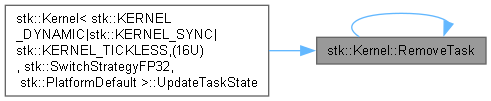
Referenced by stk::Kernel< stk::KERNEL_DYNAMIC|stk::KERNEL_SYNC|stk::KERNEL_TICKLESS,(16U), stk::SwitchStrategyFP32, stk::PlatformDefault >::RemoveTask(), and stk::Kernel< stk::KERNEL_DYNAMIC|stk::KERNEL_SYNC|stk::KERNEL_TICKLESS,(16U), stk::SwitchStrategyFP32, stk::PlatformDefault >::UpdateTaskState().

Here is the caller graph for this function:

◆ RemoveTask() [2/2]

template<uint8_t TMode, uint32_t TSize, class TStrategy, class TPlatform>
void stk::Kernel< TMode, TSize, TStrategy, TPlatform >::RemoveTask ( KernelTask * task)
inlineprotected

Remove kernel task.

Note
Removal of the kernel task means releasing it from the user task details.
Parameters
[in]taskKernel task.

Definition at line 1545 of file stk.h.

1546 {
1547 STK_ASSERT(task != nullptr);
1548
1549 #if STK_SEGGER_SYSVIEW
1550 SEGGER_SYSVIEW_OnTaskTerminate(task->GetUserStackPtr()->tid);
1551 #endif
1552
1553 // notify task about pending exit
1554 task->GetUserTask()->OnExit();
1555
1556 m_strategy.RemoveTask(task);
1557 task->Unbind();
1558 }

◆ RequestAddTask()

template<uint8_t TMode, uint32_t TSize, class TStrategy, class TPlatform>
void stk::Kernel< TMode, TSize, TStrategy, TPlatform >::RequestAddTask ( ITask *const user_task)
inlineprotected

Request to add new task.

Note
Must be called by the task process only!
Parameters
[in]user_taskUser task to add.

Definition at line 1439 of file stk.h.

1440 {
1441 KernelTask *const caller = FindTaskBySP(m_platform.GetCallerSP());
1442 STK_ASSERT(caller != nullptr);
1443
1444 typename KernelTask::AddTaskRequest req = { .user_task = user_task };
1445 caller->m_srt[0].add_task_req = &req;
1446
1447 // notify kernel
1449
1450 // switch out and wait for completion (due to context switch request could be processed here)
1451 if (caller->m_srt[0].add_task_req != nullptr)
1452 {
1453 m_service.SwitchToNext();
1454 }
1455
1456 STK_ASSERT(caller->m_srt[0].add_task_req == nullptr);
1457 }
void ScheduleAddTask()
Signal the kernel to process a pending AddTask request on the next tick.
Definition stk.h:2319
Payload for an in-flight AddTask() request issued by a running task.
Definition stk.h:144

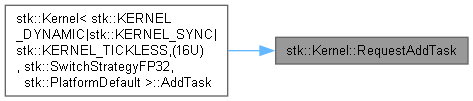
Referenced by stk::Kernel< stk::KERNEL_DYNAMIC|stk::KERNEL_SYNC|stk::KERNEL_TICKLESS,(16U), stk::SwitchStrategyFP32, stk::PlatformDefault >::AddTask().

Here is the caller graph for this function:

◆ ResumeTask()

template<uint8_t TMode, uint32_t TSize, class TStrategy, class TPlatform>
void stk::Kernel< TMode, TSize, TStrategy, TPlatform >::ResumeTask ( ITask * user_task)
inlineoverridevirtual

Resume task.

Parameters
[in]user_taskPointer to the user task to resume.

Implements stk::IKernel.

Definition at line 1157 of file stk.h.

1158 {
1159 STK_ASSERT(user_task != nullptr);
1160
1161 // avoid race with OnTick
1163
1165 STK_ASSERT(task != nullptr);
1166
1167 if (task->IsSleeping())
1168 {
1169 task->Wake();
1170 }
1171 }

◆ ScheduleAddTask()

template<uint8_t TMode, uint32_t TSize, class TStrategy, class TPlatform>
void stk::Kernel< TMode, TSize, TStrategy, TPlatform >::ScheduleAddTask ( )
inlineprotected

Signal the kernel to process a pending AddTask request on the next tick.

Note
Sets the REQ_ADD_TASK bit in m_request and emits a full memory fence so the ISR-side tick handler observes the flag without delay.

Definition at line 2319 of file stk.h.

2320 {
2323 }

Referenced by stk::Kernel< stk::KERNEL_DYNAMIC|stk::KERNEL_SYNC|stk::KERNEL_TICKLESS,(16U), stk::SwitchStrategyFP32, stk::PlatformDefault >::RequestAddTask().

Here is the caller graph for this function:

◆ ScheduleTaskRemoval()

template<uint8_t TMode, uint32_t TSize, class TStrategy, class TPlatform>
void stk::Kernel< TMode, TSize, TStrategy, TPlatform >::ScheduleTaskRemoval ( ITask * user_task)
inlineoverridevirtual

Schedule task removal from scheduling (exit).

Parameters
[in]user_taskUser task to remove. Must not be nullptr.
Warning
KERNEL_DYNAMIC mode only. Asserts if called in KERNEL_STATIC or KERNEL_HRT mode, or if called after Start().

Implements stk::IKernel.

Definition at line 1092 of file stk.h.

1093 {
1095 {
1096 STK_ASSERT(user_task != nullptr);
1098
1100
1102 if (task != nullptr)
1103 {
1104 task->ScheduleRemoval();
1105 }
1106 }
1107 else
1108 {
1109 // kernel operating mode must be KERNEL_DYNAMIC for tasks to be able to be removed
1110 STK_ASSERT(false);
1111 }
1112 }

◆ Start()

template<uint8_t TMode, uint32_t TSize, class TStrategy, class TPlatform>
void stk::Kernel< TMode, TSize, TStrategy, TPlatform >::Start ( )
inlineoverridevirtual

Start the scheduler. This call does not return until all tasks have exited (KERNEL_DYNAMIC mode) or indefinitely (KERNEL_STATIC mode).

Note
Re-initializes trap stacks on every call so Start() can be called again after a previous scheduling session ended.
If STK_SEGGER_SYSVIEW is enabled, starts tracing and registers all pre-added tasks.
Warning
At least one task must have been added via AddTask() before calling Start(). Asserts if called before Initialize().

Implements stk::IKernel.

Definition at line 1229 of file stk.h.

1230 {
1232
1233 // stacks of the traps must be re-initilized on every subsequent Start
1234 InitTraps();
1235
1236 // start tracing
1237 #if STK_SEGGER_SYSVIEW
1239 for (size_t i = 0U; i < TASKS_MAX; ++i)
1240 {
1242 if (task->IsBusy())
1243 {
1245 }
1246 }
1247 #endif
1248
1249 m_platform.Start();
1250 }
void InitTraps()
Initialize stack of the traps.
Definition stk.h:1321

◆ StateExit()

template<uint8_t TMode, uint32_t TSize, class TStrategy, class TPlatform>
bool stk::Kernel< TMode, TSize, TStrategy, TPlatform >::StateExit ( KernelTask * now,
KernelTask * next,
Stack *& idle,
Stack *& active )
inlineprotected

Exits from scheduling.

Note
FSM state: stk::FSM_STATE_EXITING.
Exits only if stk::KERNEL_DYNAMIC mode is specified, otherwise ignored.
Parameters
[in]nowCurrently active kernel task (ignored).
[in]nextNext kernel task (ignored).
[out]idleStack of the task which must enter Idle state.
[out]activeStack of the task which must enter Active state (to which context will switch).

Definition at line 2284 of file stk.h.

2285 {
2286 STK_UNUSED(now);
2288
2290 {
2291 // dynamic tasks are not supported if main processes's stack memory is not provided in Start()
2292 STK_ASSERT(m_exit_trap[0].stack.SP != 0);
2293
2294 idle = nullptr;
2295 active = &m_exit_trap[0].stack;
2296
2297 m_task_now = nullptr;
2298
2299 m_platform.Stop();
2300 }
2301 else
2302 {
2305 }
2306
2307 return false;
2308 }

Referenced by stk::Kernel< stk::KERNEL_DYNAMIC|stk::KERNEL_SYNC|stk::KERNEL_TICKLESS,(16U), stk::SwitchStrategyFP32, stk::PlatformDefault >::UpdateFsmState().

Here is the caller graph for this function:

◆ StateSleep()

template<uint8_t TMode, uint32_t TSize, class TStrategy, class TPlatform>
bool stk::Kernel< TMode, TSize, TStrategy, TPlatform >::StateSleep ( KernelTask * now,
KernelTask * next,
Stack *& idle,
Stack *& active )
inlineprotected

Enters into a sleeping mode.

Note
FSM state: stk::FSM_STATE_SLEEPING.
Parameters
[in]nowCurrently active kernel task.
[in]nextNext kernel task (ignored).
[out]idleStack of the task which must enter Idle state.
[out]activeStack of the task which must enter Active state (to which context will switch).

Definition at line 2249 of file stk.h.

2250 {
2252
2253 STK_ASSERT(now != nullptr);
2254 STK_ASSERT(m_sleep_trap[0].stack.SP != 0);
2255
2256 idle = now->GetUserStackPtr();
2257 active = &m_sleep_trap[0].stack;
2258
2260
2261 #if STK_SEGGER_SYSVIEW
2262 SEGGER_SYSVIEW_OnTaskStopReady(now->GetUserStackPtr()->tid, TRACE_EVENT_SLEEP);
2263 #endif
2264
2266 {
2267 if (!now->IsPendingRemoval())
2268 {
2269 now->HrtOnSwitchedOut();
2270 }
2271 }
2272
2273 return true; // switch context
2274 }

Referenced by stk::Kernel< stk::KERNEL_DYNAMIC|stk::KERNEL_SYNC|stk::KERNEL_TICKLESS,(16U), stk::SwitchStrategyFP32, stk::PlatformDefault >::UpdateFsmState().

Here is the caller graph for this function:

◆ StateSwitch()

template<uint8_t TMode, uint32_t TSize, class TStrategy, class TPlatform>
bool stk::Kernel< TMode, TSize, TStrategy, TPlatform >::StateSwitch ( KernelTask * now,
KernelTask * next,
Stack *& idle,
Stack *& active )
inlineprotected

Switches contexts.

Note
FSM state: stk::FSM_STATE_SWITCHING.
Parameters
[in]nowCurrently active kernel task.
[in]nextNext kernel task.
[out]idleStack of the task which must enter Idle state.
[out]activeStack of the task which must enter Active state (to which context will switch).

Definition at line 2165 of file stk.h.

2166 {
2167 STK_ASSERT(now != nullptr);
2168 STK_ASSERT(next != nullptr);
2169
2170 bool switch_context = false;
2171
2172 // if equal: do not switch context because task did not change
2173 if (next != now)
2174 {
2175 idle = now->GetUserStackPtr();
2176 active = next->GetUserStackPtr();
2177
2178 // if stack memory is exceeded these assertions will be hit
2179 if (now->IsBusy())
2180 {
2181 // current task could exit, thus we check it with IsBusy to avoid referencing nullptr returned by GetUserTask()
2182 STK_ASSERT(now->GetUserTask()->GetStack()[0] == STK_STACK_MEMORY_FILLER);
2183 }
2184 STK_ASSERT(next->GetUserTask()->GetStack()[0] == STK_STACK_MEMORY_FILLER);
2185
2186 m_task_now = next;
2187
2189 {
2190 if (now->m_hrt[0].done)
2191 {
2192 now->HrtOnSwitchedOut();
2193 next->HrtOnSwitchedIn();
2194 }
2195 }
2196
2197 #if STK_SEGGER_SYSVIEW
2198 SEGGER_SYSVIEW_OnTaskStopReady(now->GetUserStackPtr()->tid, TRACE_EVENT_SWITCH);
2199 SEGGER_SYSVIEW_OnTaskStartReady(next->GetUserStackPtr()->tid);
2200 #endif
2201
2202 switch_context = true;
2203 }
2204
2205 return switch_context;
2206 }

Referenced by stk::Kernel< stk::KERNEL_DYNAMIC|stk::KERNEL_SYNC|stk::KERNEL_TICKLESS,(16U), stk::SwitchStrategyFP32, stk::PlatformDefault >::UpdateFsmState().

Here is the caller graph for this function:

◆ StateWake()

template<uint8_t TMode, uint32_t TSize, class TStrategy, class TPlatform>
bool stk::Kernel< TMode, TSize, TStrategy, TPlatform >::StateWake ( KernelTask * now,
KernelTask * next,
Stack *& idle,
Stack *& active )
inlineprotected

Wakes up after sleeping.

Note
FSM state: stk::FSM_STATE_WAKING.
Parameters
[in]nowCurrently active kernel task (ignored).
[in]nextNext kernel task.
[out]idleStack of the task which must enter Idle state.
[out]activeStack of the task which must enter Active state (to which context will switch).

Definition at line 2215 of file stk.h.

2216 {
2217 STK_UNUSED(now);
2218
2219 STK_ASSERT(next != nullptr);
2220
2221 idle = &m_sleep_trap[0].stack;
2222 active = next->GetUserStackPtr();
2223
2224 // if stack memory is exceeded these assertions will be hit
2226 STK_ASSERT(next->GetUserTask()->GetStack()[0] == STK_STACK_MEMORY_FILLER);
2227
2228 m_task_now = next;
2229
2230 #if STK_SEGGER_SYSVIEW
2231 SEGGER_SYSVIEW_OnTaskStartReady(next->GetUserStackPtr()->tid);
2232 #endif
2233
2235 {
2236 next->HrtOnSwitchedIn();
2237 }
2238
2239 return true; // switch context
2240 }

Referenced by stk::Kernel< stk::KERNEL_DYNAMIC|stk::KERNEL_SYNC|stk::KERNEL_TICKLESS,(16U), stk::SwitchStrategyFP32, stk::PlatformDefault >::UpdateFsmState().

Here is the caller graph for this function:

◆ SuspendTask()

template<uint8_t TMode, uint32_t TSize, class TStrategy, class TPlatform>
void stk::Kernel< TMode, TSize, TStrategy, TPlatform >::SuspendTask ( ITask * user_task,
bool & suspended )
inlineoverridevirtual

Suspend task.

Parameters
[in]user_taskPointer to the user task to suspend.
[out]suspendedSet to true if task is suspended.
Note
hw::CriticalSection must not be active otherwise a deadlock will happen if task is suspending self.

Implements stk::IKernel.

Definition at line 1120 of file stk.h.

1121 {
1122 STK_ASSERT(user_task != nullptr);
1123
1124 bool self = false;
1125
1126 // avoid race with OnTick
1127 {
1129
1131 STK_ASSERT(task != nullptr);
1132
1133 // only suspend if the task is currently awake: if it is already sleeping
1134 // (e.g. blocked on a mutex or timed Sleep), do not overwrite m_time_sleep,
1135 // that would corrupt the original sleep state and, for sync-object waits,
1136 // would interfere with WaitObject::Tick()
1137 suspended = !task->IsSleeping();
1138 if (suspended == true)
1139 {
1140 task->ScheduleSleep(WAIT_INFINITE);
1141
1142 // check if suspending self
1143 self = (task == m_task_now);
1144 }
1145 }
1146
1147 // note: we do not spin long here, kernel will switch this task out from scheduling on the next tick
1148 if (self)
1149 {
1150 m_task_now->BusyWaitWhileSleeping();
1151 }
1152 }

◆ UpdateFsmState()

template<uint8_t TMode, uint32_t TSize, class TStrategy, class TPlatform>
bool stk::Kernel< TMode, TSize, TStrategy, TPlatform >::UpdateFsmState ( Stack *& idle,
Stack *& active )
inlineprotected

Update FSM state.

Parameters
[out]idleStack of the task which must enter Idle state.
[out]activeStack of the task which must enter Active state (to which context will switch).
Returns
FSM state.

Definition at line 2122 of file stk.h.

2123 {
2124 KernelTask *const now = m_task_now, *next = nullptr;
2125 bool switch_context = false;
2126
2128
2129 switch (new_state)
2130 {
2134 break;
2135 case FSM_STATE_SLEEPING:
2138 break;
2139 case FSM_STATE_WAKING:
2142 break;
2143 case FSM_STATE_EXITING:
2146 break;
2147 case FSM_STATE_NONE:
2148 break; // valid intermittent non-persisting state: no-transition
2149 case FSM_STATE_MAX:
2150 default: // invalid state value
2152 break;
2153 }
2154
2155 return switch_context;
2156 }
EFsmState
Finite-state machine (FSM) state. Encodes what the kernel is currently doing between two consecutive ...
Definition stk.h:1281
bool StateWake(KernelTask *now, KernelTask *next, Stack *&idle, Stack *&active)
Wakes up after sleeping.
Definition stk.h:2215
bool StateExit(KernelTask *now, KernelTask *next, Stack *&idle, Stack *&active)
Exits from scheduling.
Definition stk.h:2284
bool StateSwitch(KernelTask *now, KernelTask *next, Stack *&idle, Stack *&active)
Switches contexts.
Definition stk.h:2165
bool StateSleep(KernelTask *now, KernelTask *next, Stack *&idle, Stack *&active)
Enters into a sleeping mode.
Definition stk.h:2249

Referenced by stk::Kernel< stk::KERNEL_DYNAMIC|stk::KERNEL_SYNC|stk::KERNEL_TICKLESS,(16U), stk::SwitchStrategyFP32, stk::PlatformDefault >::OnTick().

Here is the caller graph for this function:

◆ UpdateSyncObjects()

template<uint8_t TMode, uint32_t TSize, class TStrategy, class TPlatform>
void stk::Kernel< TMode, TSize, TStrategy, TPlatform >::UpdateSyncObjects ( const Timeout elapsed_ticks)
inlineprotected

Update synchronization objects.

Definition at line 2019 of file stk.h.

2020 {
2022
2023 while (itr != nullptr)
2024 {
2025 ISyncObject::ListEntryType *const next = itr->GetNext();
2026
2028 {
2029 m_sync_list->Unlink(itr);
2030 }
2031
2032 itr = next;
2033 }
2034 }

Referenced by stk::Kernel< stk::KERNEL_DYNAMIC|stk::KERNEL_SYNC|stk::KERNEL_TICKLESS,(16U), stk::SwitchStrategyFP32, stk::PlatformDefault >::UpdateTasks().

Here is the caller graph for this function:

◆ UpdateTaskRequest()

template<uint8_t TMode, uint32_t TSize, class TStrategy, class TPlatform>
void stk::Kernel< TMode, TSize, TStrategy, TPlatform >::UpdateTaskRequest ( )
inlineprotected

Update pending task requests.

Definition at line 2038 of file stk.h.

2039 {
2040 // process AddTask requests coming from tasks (KERNEL_DYNAMIC mode only, KERNEL_HRT is
2041 // excluded as we assume that HRT tasks must be known to the kernel before a Start())
2043 {
2044 // process serialized AddTask request made from another active task, requesting process
2045 // is currently waiting due to SwitchToNext()
2046 if ((m_request & REQ_ADD_TASK) != 0U)
2047 {
2049
2050 for (size_t i = 0U; i < TASKS_MAX; ++i)
2051 {
2052 KernelTask *const task = &m_task_storage[i];
2053
2054 if (task->m_srt[0].add_task_req != nullptr)
2055 {
2056 AllocateAndAddNewTask(task->m_srt[0].add_task_req->user_task);
2057
2058 task->m_srt[0].add_task_req = nullptr;
2060 }
2061 }
2062 }
2063 }
2064 }

Referenced by stk::Kernel< stk::KERNEL_DYNAMIC|stk::KERNEL_SYNC|stk::KERNEL_TICKLESS,(16U), stk::SwitchStrategyFP32, stk::PlatformDefault >::UpdateTasks().

Here is the caller graph for this function:

◆ UpdateTasks()

template<uint8_t TMode, uint32_t TSize, class TStrategy, class TPlatform>
Timeout stk::Kernel< TMode, TSize, TStrategy, TPlatform >::UpdateTasks ( const Timeout elapsed_ticks)
inlineprotected

Update tasks (sleep, requests).

Definition at line 1897 of file stk.h.

1898 {
1899 // sync objects are updated before UpdateTaskRequest which may add a new object (newly added object must become 1 tick older)
1901 {
1903 }
1904
1905 if (m_request != REQ_NONE)
1906 {
1908 }
1909
1911 }
void UpdateTaskRequest()
Update pending task requests.
Definition stk.h:2038
Timeout UpdateTaskState(const Timeout elapsed_ticks)
Update task state: process removals, advance sleep timers, and track HRT durations.
Definition stk.h:1922
void UpdateSyncObjects(const Timeout elapsed_ticks)
Update synchronization objects.
Definition stk.h:2019

Referenced by stk::Kernel< stk::KERNEL_DYNAMIC|stk::KERNEL_SYNC|stk::KERNEL_TICKLESS,(16U), stk::SwitchStrategyFP32, stk::PlatformDefault >::OnTick().

Here is the caller graph for this function:

◆ UpdateTaskState()

template<uint8_t TMode, uint32_t TSize, class TStrategy, class TPlatform>
Timeout stk::Kernel< TMode, TSize, TStrategy, TPlatform >::UpdateTaskState ( const Timeout elapsed_ticks)
inlineprotected

Update task state: process removals, advance sleep timers, and track HRT durations.

Parameters
[in]elapsed_ticksNumber of ticks elapsed since the previous call. Always 1 in non-tickless mode, may be >1 in tickless mode.
Returns
In non-tickless mode: always 1. In tickless mode (KERNEL_TICKLESS): the minimum remaining sleep ticks across all active tasks, clamped to [1, STK_TICKLESS_TICKS_MAX]. The platform driver uses this value to program the next timer wakeup interval, suppressing timer/tick ISR for that many ticks when the system would otherwise be idle.

Definition at line 1922 of file stk.h.

1923 {
1925
1926 for (size_t i = 0U; i < TASKS_MAX; ++i)
1927 {
1928 KernelTask *const task = &m_task_storage[i];
1929
1930 if (task->IsSleeping())
1931 {
1933 {
1934 // task is pending removal, wait until it is switched out
1935 if (task->IsPendingRemoval())
1936 {
1937 const size_t tasks_left = m_strategy.GetSize();
1938
1939 if ((task != m_task_now) ||
1940 ((tasks_left == 1U) && (m_fsm_state == FSM_STATE_SLEEPING)))
1941 {
1943 continue;
1944 }
1945 }
1946 }
1947
1948 // deliver sleep event to strategy
1949 // note: only currently scheduled task can be pending to sleep
1951 {
1952 if ((task->m_state & KernelTask::STATE_SLEEP_PENDING) != 0U)
1953 {
1955
1956 // notify strategy that task is sleeping
1957 m_strategy.OnTaskSleep(task);
1958 }
1959 }
1960
1961 // advance sleep time by a tick
1962 task->m_time_sleep += elapsed_ticks;
1963
1964 // deliver sleep event to strategy
1966 {
1967 // notify strategy that task woke up
1968 if (!task->IsSleeping())
1969 {
1970 m_strategy.OnTaskWake(task);
1971 }
1972 }
1973 }
1974 else
1975 {
1977 {
1978 // in HRT mode we trace how long task spent in active state (doing some work)
1979 if (task->IsBusy())
1980 {
1981 task->m_hrt[0].duration += elapsed_ticks;
1982
1983 // check if deadline is missed (HRT failure)
1984 if (task->HrtIsDeadlineMissed(task->m_hrt[0].duration))
1985 {
1986 // report deadline overrun to a strategy which supports overrun recovery
1988 {
1989 if (!m_strategy.OnTaskDeadlineMissed(task))
1990 {
1991 // report failure if it could not be recovered by the scheduling strategy
1992 task->HrtHardFailDeadline(&m_platform);
1993 }
1994 }
1995 else
1996 {
1997 task->HrtHardFailDeadline(&m_platform);
1998 }
1999 }
2000 }
2001 }
2002 }
2003
2004 // get the number ticks the driver has to keep CPU in Idle
2006 {
2007 if ((sleep_ticks > 1) && task->IsBusy())
2008 {
2009 sleep_ticks = task->GetSleepTicks(sleep_ticks);
2010 }
2011 }
2012 }
2013
2014 return sleep_ticks;
2015 }
Timeout GetInitialSleepTicks()
static constexpr bool IsTicklessMode()
Definition stk.h:2351

Referenced by stk::Kernel< stk::KERNEL_DYNAMIC|stk::KERNEL_SYNC|stk::KERNEL_TICKLESS,(16U), stk::SwitchStrategyFP32, stk::PlatformDefault >::UpdateTasks().

Here is the caller graph for this function:

Member Data Documentation

◆ m_exit_trap

template<uint8_t TMode, uint32_t TSize, class TStrategy, class TPlatform>
ExitTrapStack stk::Kernel< TMode, TSize, TStrategy, TPlatform >::m_exit_trap[STK_ALLOCATE_COUNT< TMode, KERNEL_DYNAMIC, 1U, 0U >::Value]
protected

Exit trap: zero-size in KERNEL_STATIC mode; one entry in KERNEL_DYNAMIC mode.

Definition at line 2425 of file stk.h.

◆ m_fsm

template<uint8_t TMode, uint32_t TSize, class TStrategy, class TPlatform>
const EFsmState stk::Kernel< TMode, TSize, TStrategy, TPlatform >::m_fsm[FSM_STATE_MAX][FSM_EVENT_MAX]
protected
Initial value:

Compile-time FSM transition table. Indexed as m_fsm[current_state][event] -> next_state. FSM_STATE_NONE as a next-state means "no transition": the FSM stays in the current state. Updated by UpdateFsmState() each tick via GetNewFsmState() -> FetchNextEvent().

Definition at line 2431 of file stk.h.

2431 {
2432 // FSM_EVENT_SWITCH FSM_EVENT_SLEEP FSM_EVENT_WAKE FSM_EVENT_EXIT
2437 };

◆ m_fsm_state

template<uint8_t TMode, uint32_t TSize, class TStrategy, class TPlatform>
EFsmState stk::Kernel< TMode, TSize, TStrategy, TPlatform >::m_fsm_state
protected

Current FSM state. Drives context-switch decision on every tick.

Definition at line 2426 of file stk.h.

◆ m_kstate

template<uint8_t TMode, uint32_t TSize, class TStrategy, class TPlatform>
volatile EKernelState stk::Kernel< TMode, TSize, TStrategy, TPlatform >::m_kstate
protected

Current kernel state.

Definition at line 2428 of file stk.h.

◆ m_platform

template<uint8_t TMode, uint32_t TSize, class TStrategy, class TPlatform>
TPlatform stk::Kernel< TMode, TSize, TStrategy, TPlatform >::m_platform
protected

Platform driver (SysTick, PendSV, context switch implementation).

Definition at line 2420 of file stk.h.

◆ m_request

template<uint8_t TMode, uint32_t TSize, class TStrategy, class TPlatform>
volatile uint8_t stk::Kernel< TMode, TSize, TStrategy, TPlatform >::m_request
protected

Bitmask of pending ERequest flags from running tasks. Written by tasks, read/cleared by UpdateTaskRequest() in tick context.

Definition at line 2427 of file stk.h.

◆ m_service

template<uint8_t TMode, uint32_t TSize, class TStrategy, class TPlatform>
KernelService stk::Kernel< TMode, TSize, TStrategy, TPlatform >::m_service
protected

Kernel service singleton exposed to running tasks via IKernelService::GetInstance().

Definition at line 2419 of file stk.h.

◆ m_sleep_trap

template<uint8_t TMode, uint32_t TSize, class TStrategy, class TPlatform>
SleepTrapStack stk::Kernel< TMode, TSize, TStrategy, TPlatform >::m_sleep_trap[1]
protected

Sleep trap (always present): executed when all tasks are sleeping.

Definition at line 2424 of file stk.h.

◆ m_strategy

template<uint8_t TMode, uint32_t TSize, class TStrategy, class TPlatform>
TStrategy stk::Kernel< TMode, TSize, TStrategy, TPlatform >::m_strategy
protected

Task-switching strategy (determines which task runs next).

Definition at line 2421 of file stk.h.

◆ m_sync_list

template<uint8_t TMode, uint32_t TSize, class TStrategy, class TPlatform>
SyncObjectList stk::Kernel< TMode, TSize, TStrategy, TPlatform >::m_sync_list[STK_ALLOCATE_COUNT< TMode, KERNEL_SYNC, 1U, 0U >::Value]
protected

List of active sync objects. Zero-size (no memory) if KERNEL_SYNC is not set.

Definition at line 2429 of file stk.h.

◆ m_task_now

template<uint8_t TMode, uint32_t TSize, class TStrategy, class TPlatform>
KernelTask* stk::Kernel< TMode, TSize, TStrategy, TPlatform >::m_task_now
protected

Currently executing task, or nullptr before Start() or after all tasks exit.

Definition at line 2422 of file stk.h.

◆ m_task_storage

template<uint8_t TMode, uint32_t TSize, class TStrategy, class TPlatform>
TaskStorageType stk::Kernel< TMode, TSize, TStrategy, TPlatform >::m_task_storage
protected

Static pool of TSize KernelTask slots (free slots have m_user == nullptr).

Definition at line 2423 of file stk.h.

◆ TASKS_MAX

template<uint8_t TMode, uint32_t TSize, class TStrategy, class TPlatform>
size_t stk::Kernel< TMode, TSize, TStrategy, TPlatform >::TASKS_MAX = TSize
staticconstexpr

Maximum number of concurrently registered tasks. Fixed at compile time. Exceeding this limit in AddTask() triggers a compile-time assert (TASKS_MAX > 0) and a runtime STK_ASSERT.

Definition at line 924 of file stk.h.

◆ YIELD_TICKS

template<uint8_t TMode, uint32_t TSize, class TStrategy, class TPlatform>
Timeout stk::Kernel< TMode, TSize, TStrategy, TPlatform >::YIELD_TICKS = 2
staticconstexprprotected

Ticks to yield.

Yield with 2 ticks: 1 will be incremented on the next OnTick call by UpdateTasks and remaining 1 will cause a context switch by UpdateFsmState when strategy detects it as a sleeping test.

Definition at line 1309 of file stk.h.


The documentation for this class was generated from the following file: